Which Foods Have the Highest Natural Levels of NMN?
Skip to content
Getting NMN via natural sources of food is the most healthy way to boost <!– wp:image {“align”:”left”,”id”:6104,”sizeSlug”:”full”,”linkDestination”:”none”} –><figure class=”wp-block-image alignleft size-full”></figure><!– /wp:image –><!– wp:paragraph –>NAD, or nicotinamide adenine dinucleotide, is a coenzyme that is found in all cells and is essential to metabolism, in short NAD is critical in the chemical reactions that give all cells their energy, no or low NAD then cells don’t get the energy they need to function correctly.<br/><!– /wp:paragraph –><!– wp:paragraph –>More technically its significance lies in its role in redox reactions, where it carries electrons from one reaction to another. NAD exists in two forms: NAD⁺ and NADH, with the former serving as an oxidizing agent that accepts electrons from other molecules and becomes reduced, forming NADH, which can then be used as a reducing agent to donate electrons. This electron transfer is the primary function of NAD and plays a critical role in metabolism.<br/><!– /wp:paragraph –><!– wp:paragraph –>Additionally, NAD is used in other cellular processes, particularly as a substrate of enzymes in adding or removing chemical groups to or from proteins in posttranslational modifications. Due to its importance, enzymes involved in NAD metabolism are targets for drug discovery.<br>NAD⁺ has two general reactions in the human body: helping turn nutrients into energy as a key player in metabolism and working as a helper molecule for proteins that regulate other cellular functions. These processes are vital as NAD⁺ levels decline with age.<br/><!– /wp:paragraph –><!– wp:paragraph –>NAD can be synthesized de novo from simple building blocks like tryptophan or aspartic acid or derived from nutritive compounds like niacin. Moreover, some NAD is converted into the coenzyme nicotinamide adenine dinucleotide phosphate (NADP), which is a cofactor in anabolic metabolism.<br>The NAD⁺ chemical species’ superscripted addition sign reflects the formal charge on one of its nitrogen atoms; this species is a singly charged anion – carrying a (negative) ionic charge of 1 – under conditions of physiological pH.<br/><!– /wp:paragraph –><!– wp:heading –>Should I Supplement with NAD⁺ or a Precurcor like NMN or NR<!– /wp:heading –><!– wp:paragraph –>While we want to increase levels of NAD⁺ in our bodies, supplementing directly with NAD⁺ is not the answer; the reason is that NAD⁺ is a large molecule, so it’s always broken down in the stomach; the solution is to supplement with a precursor like NMN or NR.<br/><!– /wp:paragraph –><!– wp:paragraph –>There are several NAD⁺ precursors; these include:<br/><!– /wp:paragraph –><!– wp:list –><!– wp:list-item –>Nicotinamide Riboside (NR)<br/><!– /wp:list-item –><!– wp:list-item –> Nicotinic Acid (NA)<br/><!– /wp:list-item –><!– wp:list-item –> Nicotinamide (NAM)<br/><!– /wp:list-item –><!– wp:list-item –> Nicotinamide Mononucleotide (NMN)<br/><!– /wp:list-item –><!– wp:list-item –> Tryptophan (TRP)<br/><!– /wp:list-item –><br/><!– /wp:list –><!– wp:paragraph –>The latest research suggests that supplementing with NMN is the most effective way of boosting NAD⁺, much better than supplementing with NR, as you will see in the diagram below as NMN is closer in the NAD⁺ Biosynthetic Pathway, in short NR first needs to be converted into NMN before NAD⁺.<br/><!– /wp:paragraph –><!– wp:image {“align”:”center”,”id”:6103,”sizeSlug”:”full”,”linkDestination”:”none”} –><figure class=”wp-block-image aligncenter size-full”></figure><!– /wp:image –><!– wp:heading –>NAD History and Research<!– /wp:heading –><!– wp:paragraph –>The discovery of NAD⁺ can be credited to the British biochemists Arthur Harden and William John Young in 1906, who identified it as a nucleotide sugar phosphate by Hans von Euler-Chelpin. Otto Heinrich Warburg advanced the science in the 1930s by researching NAD+ and its role in metabolic reactions. Later, Conrad Elvehjem discovered that niacin is used to synthesize NAD⁺.<br/><!– /wp:paragraph –><!– wp:paragraph –>Recent research has also shown that NAD⁺ is critical in promoting longevity. Studies have found that boosting NAD⁺ levels can improve mitochondrial function, increase energy production, and enhance DNA repair. Furthermore, NAD⁺ has been shown to activate sirtuins, a group of enzymes associated with aging and longevity.<br/><!– /wp:paragraph –><!– wp:paragraph –>In addition to its role in metabolism and cellular processes, NAD⁺ is also involved in various disease states. For example, NAD⁺ levels decrease in several age-related diseases, including Alzheimer’s disease and Parkinson’s disease. Moreover, NAD⁺ has been shown to play a protective role in cardiovascular diseases, such as heart failure and hypertension.<br/><!– /wp:paragraph –>
” href=”https://longevityfaq.com/glossary/nad/” data-mobile-support=”0″ data-gt-translate-attributes=”[{“attribute”:”data-cmtooltip”, “format”:”html”}]” tabindex=’0′ role=”link”>NAD levels longevity, however what foods contain the higest levels of NMN and is obtaining NMN naturally the best method way to boost NAD, or nicotinamide adenine dinucleotide, is a coenzyme that is found in all cells and is essential to metabolism, in short NAD is critical in the chemical reactions that give all cells their energy, no or low NAD then cells don’t get the energy they need to function correctly.More technically its significance lies in its role in redox reactions, where it carries electrons from one reaction to another. NAD exists in two forms: NAD⁺ and NADH, with the former serving as an oxidizing agent that accepts electrons from other molecules and becomes reduced, forming NADH, which can then be used as a reducing agent to donate electrons. This electron transfer is the primary function of NAD and plays a critical role in metabolism.Additionally, NAD is used in other cellular processes, particularly as a substrate of enzymes in adding or removing chemical groups to or from proteins in posttranslational modifications. Due to its importance, enzymes involved in NAD metabolism are targets for drug discovery.NAD⁺ has two general reactions in the human body: helping turn nutrients into energy as a key player in metabolism and working as a helper molecule for proteins that regulate other cellular functions. These processes are vital as NAD⁺ levels decline with age.NAD can be synthesized de novo from simple building blocks like tryptophan or aspartic acid or derived from nutritive compounds like niacin. Moreover, some NAD is converted into the coenzyme nicotinamide adenine dinucleotide phosphate (NADP), which is a cofactor in anabolic metabolism.The NAD⁺ chemical species’ superscripted addition sign reflects the formal charge on one of its nitrogen atoms; this species is a singly charged anion – carrying a (negative) ionic charge of 1 – under conditions of physiological pH.Should I Supplement with NAD⁺ or a Precurcor like NMN or NRWhile we want to increase levels of NAD⁺ in our bodies, supplementing directly with NAD⁺ is not the answer; the reason is that NAD⁺ is a large molecule, so it’s always broken down in the stomach; the solution is to supplement with a precursor like NMN or NR.There are several NAD⁺ precursors; these include:Nicotinamide Riboside (NR) Nicotinic Acid (NA) Nicotinamide (NAM) Nicotinamide Mononucleotide (NMN) Tryptophan (TRP)The latest research suggests that supplementing with NMN is the most effective way of boosting NAD⁺, much better than supplementing with NR, as you will see in the diagram below as NMN is closer in the NAD⁺ Biosynthetic Pathway, in short NR first needs to be converted into NMN before NAD⁺.NAD History and ResearchThe discovery of NAD⁺ can be credited to the British biochemists Arthur Harden and William John Young in 1906, who identified it as a nucleotide sugar phosphate by Hans von Euler-Chelpin. Otto Heinrich Warburg advanced the science in the 1930s by researching NAD+ and its role in metabolic reactions. Later, Conrad Elvehjem discovered that niacin is used to synthesize NAD⁺.Recent research has also shown that NAD⁺ is critical in promoting longevity. Studies have found that boosting NAD⁺ levels can improve mitochondrial function, increase energy production, and enhance DNA repair. Furthermore, NAD⁺ has been shown to activate sirtuins, a group of enzymes associated with aging and longevity.In addition to its role in metabolism and cellular processes, NAD⁺ is also involved in various disease states. For example, NAD⁺ levels decrease in several age-related diseases, including Alzheimer’s disease and Parkinson’s disease. Moreover, NAD⁺ has been shown to play a protective role in cardiovascular diseases, such as heart failure and hypertension.
” href=”https://longevityfaq.com/glossary/nad/” data-mobile-support=”0″ data-gt-translate-attributes=”[{“attribute”:”data-cmtooltip”, “format”:”html”}]” tabindex=’0′ role=”link”>NAD.
As time marches on, your body’s ability to stay youthful doesn’t quite keep the same pace, and that’s where NMN steps in. You’ve probably wondered how you can support your health as the years add up. Well, it turns out that some of the answers might be hiding in plain sight, right there on your plate.
Foods packed with NMN, a key player in energy production and longevity, could be your ticket to maintaining vitality. You’ll find NMN naturally in a variety of foods, and you might be curious about which ones offer the most.
Stick around, and you’ll uncover the edible treasures that can help keep your cells dancing to the tune of youth.
Key Takeaways
- While NMN can be consumed naturally in food, only Supplementation can adequately boost <!– wp:image {“align”:”left”,”id”:6104,”sizeSlug”:”full”,”linkDestination”:”none”} –><figure class=”wp-block-image alignleft size-full”></figure><!– /wp:image –><!– wp:paragraph –>NAD, or nicotinamide adenine dinucleotide, is a coenzyme that is found in all cells and is essential to metabolism, in short NAD is critical in the chemical reactions that give all cells their energy, no or low NAD then cells don’t get the energy they need to function correctly.<br/><!– /wp:paragraph –><!– wp:paragraph –>More technically its significance lies in its role in redox reactions, where it carries electrons from one reaction to another. NAD exists in two forms: NAD⁺ and NADH, with the former serving as an oxidizing agent that accepts electrons from other molecules and becomes reduced, forming NADH, which can then be used as a reducing agent to donate electrons. This electron transfer is the primary function of NAD and plays a critical role in metabolism.<br/><!– /wp:paragraph –><!– wp:paragraph –>Additionally, NAD is used in other cellular processes, particularly as a substrate of enzymes in adding or removing chemical groups to or from proteins in posttranslational modifications. Due to its importance, enzymes involved in NAD metabolism are targets for drug discovery.<br>NAD⁺ has two general reactions in the human body: helping turn nutrients into energy as a key player in metabolism and working as a helper molecule for proteins that regulate other cellular functions. These processes are vital as NAD⁺ levels decline with age.<br/><!– /wp:paragraph –><!– wp:paragraph –>NAD can be synthesized de novo from simple building blocks like tryptophan or aspartic acid or derived from nutritive compounds like niacin. Moreover, some NAD is converted into the coenzyme nicotinamide adenine dinucleotide phosphate (NADP), which is a cofactor in anabolic metabolism.<br>The NAD⁺ chemical species’ superscripted addition sign reflects the formal charge on one of its nitrogen atoms; this species is a singly charged anion – carrying a (negative) ionic charge of 1 – under conditions of physiological pH.<br/><!– /wp:paragraph –><!– wp:heading –>Should I Supplement with NAD⁺ or a Precurcor like NMN or NR<!– /wp:heading –><!– wp:paragraph –>While we want to increase levels of NAD⁺ in our bodies, supplementing directly with NAD⁺ is not the answer; the reason is that NAD⁺ is a large molecule, so it’s always broken down in the stomach; the solution is to supplement with a precursor like NMN or NR.<br/><!– /wp:paragraph –><!– wp:paragraph –>There are several NAD⁺ precursors; these include:<br/><!– /wp:paragraph –><!– wp:list –><!– wp:list-item –>Nicotinamide Riboside (NR)<br/><!– /wp:list-item –><!– wp:list-item –> Nicotinic Acid (NA)<br/><!– /wp:list-item –><!– wp:list-item –> Nicotinamide (NAM)<br/><!– /wp:list-item –><!– wp:list-item –> Nicotinamide Mononucleotide (NMN)<br/><!– /wp:list-item –><!– wp:list-item –> Tryptophan (TRP)<br/><!– /wp:list-item –><br/><!– /wp:list –><!– wp:paragraph –>The latest research suggests that supplementing with NMN is the most effective way of boosting NAD⁺, much better than supplementing with NR, as you will see in the diagram below as NMN is closer in the NAD⁺ Biosynthetic Pathway, in short NR first needs to be converted into NMN before NAD⁺.<br/><!– /wp:paragraph –><!– wp:image {“align”:”center”,”id”:6103,”sizeSlug”:”full”,”linkDestination”:”none”} –><figure class=”wp-block-image aligncenter size-full”></figure><!– /wp:image –><!– wp:heading –>NAD History and Research<!– /wp:heading –><!– wp:paragraph –>The discovery of NAD⁺ can be credited to the British biochemists Arthur Harden and William John Young in 1906, who identified it as a nucleotide sugar phosphate by Hans von Euler-Chelpin. Otto Heinrich Warburg advanced the science in the 1930s by researching NAD+ and its role in metabolic reactions. Later, Conrad Elvehjem discovered that niacin is used to synthesize NAD⁺.<br/><!– /wp:paragraph –><!– wp:paragraph –>Recent research has also shown that NAD⁺ is critical in promoting longevity. Studies have found that boosting NAD⁺ levels can improve mitochondrial function, increase energy production, and enhance DNA repair. Furthermore, NAD⁺ has been shown to activate sirtuins, a group of enzymes associated with aging and longevity.<br/><!– /wp:paragraph –><!– wp:paragraph –>In addition to its role in metabolism and cellular processes, NAD⁺ is also involved in various disease states. For example, NAD⁺ levels decrease in several age-related diseases, including Alzheimer’s disease and Parkinson’s disease. Moreover, NAD⁺ has been shown to play a protective role in cardiovascular diseases, such as heart failure and hypertension.<br/><!– /wp:paragraph –>
” href=”https://longevityfaq.com/glossary/nad/” data-mobile-support=”0″ data-gt-translate-attributes=”[{“attribute”:”data-cmtooltip”, “format”:”html”}]” tabindex=’0′ role=”link”>NAD+ Levels.
Understanding NMN and NAD
NMN a type of molicule called a nucleotide is one of the building blocks of RNA and DNA, that are crucial for creating <!– wp:image {“align”:”left”,”id”:6104,”sizeSlug”:”full”,”linkDestination”:”none”} –><figure class=”wp-block-image alignleft size-full”></figure><!– /wp:image –><!– wp:paragraph –>NAD, or nicotinamide adenine dinucleotide, is a coenzyme that is found in all cells and is essential to metabolism, in short NAD is critical in the chemical reactions that give all cells their energy, no or low NAD then cells don’t get the energy they need to function correctly.<br/><!– /wp:paragraph –><!– wp:paragraph –>More technically its significance lies in its role in redox reactions, where it carries electrons from one reaction to another. NAD exists in two forms: NAD⁺ and NADH, with the former serving as an oxidizing agent that accepts electrons from other molecules and becomes reduced, forming NADH, which can then be used as a reducing agent to donate electrons. This electron transfer is the primary function of NAD and plays a critical role in metabolism.<br/><!– /wp:paragraph –><!– wp:paragraph –>Additionally, NAD is used in other cellular processes, particularly as a substrate of enzymes in adding or removing chemical groups to or from proteins in posttranslational modifications. Due to its importance, enzymes involved in NAD metabolism are targets for drug discovery.<br>NAD⁺ has two general reactions in the human body: helping turn nutrients into energy as a key player in metabolism and working as a helper molecule for proteins that regulate other cellular functions. These processes are vital as NAD⁺ levels decline with age.<br/><!– /wp:paragraph –><!– wp:paragraph –>NAD can be synthesized de novo from simple building blocks like tryptophan or aspartic acid or derived from nutritive compounds like niacin. Moreover, some NAD is converted into the coenzyme nicotinamide adenine dinucleotide phosphate (NADP), which is a cofactor in anabolic metabolism.<br>The NAD⁺ chemical species’ superscripted addition sign reflects the formal charge on one of its nitrogen atoms; this species is a singly charged anion – carrying a (negative) ionic charge of 1 – under conditions of physiological pH.<br/><!– /wp:paragraph –><!– wp:heading –>Should I Supplement with NAD⁺ or a Precurcor like NMN or NR<!– /wp:heading –><!– wp:paragraph –>While we want to increase levels of NAD⁺ in our bodies, supplementing directly with NAD⁺ is not the answer; the reason is that NAD⁺ is a large molecule, so it’s always broken down in the stomach; the solution is to supplement with a precursor like NMN or NR.<br/><!– /wp:paragraph –><!– wp:paragraph –>There are several NAD⁺ precursors; these include:<br/><!– /wp:paragraph –><!– wp:list –><!– wp:list-item –>Nicotinamide Riboside (NR)<br/><!– /wp:list-item –><!– wp:list-item –> Nicotinic Acid (NA)<br/><!– /wp:list-item –><!– wp:list-item –> Nicotinamide (NAM)<br/><!– /wp:list-item –><!– wp:list-item –> Nicotinamide Mononucleotide (NMN)<br/><!– /wp:list-item –><!– wp:list-item –> Tryptophan (TRP)<br/><!– /wp:list-item –><br/><!– /wp:list –><!– wp:paragraph –>The latest research suggests that supplementing with NMN is the most effective way of boosting NAD⁺, much better than supplementing with NR, as you will see in the diagram below as NMN is closer in the NAD⁺ Biosynthetic Pathway, in short NR first needs to be converted into NMN before NAD⁺.<br/><!– /wp:paragraph –><!– wp:image {“align”:”center”,”id”:6103,”sizeSlug”:”full”,”linkDestination”:”none”} –><figure class=”wp-block-image aligncenter size-full”></figure><!– /wp:image –><!– wp:heading –>NAD History and Research<!– /wp:heading –><!– wp:paragraph –>The discovery of NAD⁺ can be credited to the British biochemists Arthur Harden and William John Young in 1906, who identified it as a nucleotide sugar phosphate by Hans von Euler-Chelpin. Otto Heinrich Warburg advanced the science in the 1930s by researching NAD+ and its role in metabolic reactions. Later, Conrad Elvehjem discovered that niacin is used to synthesize NAD⁺.<br/><!– /wp:paragraph –><!– wp:paragraph –>Recent research has also shown that NAD⁺ is critical in promoting longevity. Studies have found that boosting NAD⁺ levels can improve mitochondrial function, increase energy production, and enhance DNA repair. Furthermore, NAD⁺ has been shown to activate sirtuins, a group of enzymes associated with aging and longevity.<br/><!– /wp:paragraph –><!– wp:paragraph –>In addition to its role in metabolism and cellular processes, NAD⁺ is also involved in various disease states. For example, NAD⁺ levels decrease in several age-related diseases, including Alzheimer’s disease and Parkinson’s disease. Moreover, NAD⁺ has been shown to play a protective role in cardiovascular diseases, such as heart failure and hypertension.<br/><!– /wp:paragraph –>
” href=”https://longevityfaq.com/glossary/nad/” data-mobile-support=”0″ data-gt-translate-attributes=”[{“attribute”:”data-cmtooltip”, “format”:”html”}]” tabindex=’0′ role=”link”>NAD+, which your cells need to turn food into energy and maintain healthy functions. Your body has this substance called NMN, short for nicotinamide mononucleotide. It’s naturally occurring and plays a big part in how your cells work.
Now, NMN is a step before (precurcor to) something called <!– wp:image {“align”:”left”,”id”:6104,”sizeSlug”:”full”,”linkDestination”:”none”} –><figure class=”wp-block-image alignleft size-full”></figure><!– /wp:image –><!– wp:paragraph –>NAD, or nicotinamide adenine dinucleotide, is a coenzyme that is found in all cells and is essential to metabolism, in short NAD is critical in the chemical reactions that give all cells their energy, no or low NAD then cells don’t get the energy they need to function correctly.<br/><!– /wp:paragraph –><!– wp:paragraph –>More technically its significance lies in its role in redox reactions, where it carries electrons from one reaction to another. NAD exists in two forms: NAD⁺ and NADH, with the former serving as an oxidizing agent that accepts electrons from other molecules and becomes reduced, forming NADH, which can then be used as a reducing agent to donate electrons. This electron transfer is the primary function of NAD and plays a critical role in metabolism.<br/><!– /wp:paragraph –><!– wp:paragraph –>Additionally, NAD is used in other cellular processes, particularly as a substrate of enzymes in adding or removing chemical groups to or from proteins in posttranslational modifications. Due to its importance, enzymes involved in NAD metabolism are targets for drug discovery.<br>NAD⁺ has two general reactions in the human body: helping turn nutrients into energy as a key player in metabolism and working as a helper molecule for proteins that regulate other cellular functions. These processes are vital as NAD⁺ levels decline with age.<br/><!– /wp:paragraph –><!– wp:paragraph –>NAD can be synthesized de novo from simple building blocks like tryptophan or aspartic acid or derived from nutritive compounds like niacin. Moreover, some NAD is converted into the coenzyme nicotinamide adenine dinucleotide phosphate (NADP), which is a cofactor in anabolic metabolism.<br>The NAD⁺ chemical species’ superscripted addition sign reflects the formal charge on one of its nitrogen atoms; this species is a singly charged anion – carrying a (negative) ionic charge of 1 – under conditions of physiological pH.<br/><!– /wp:paragraph –><!– wp:heading –>Should I Supplement with NAD⁺ or a Precurcor like NMN or NR<!– /wp:heading –><!– wp:paragraph –>While we want to increase levels of NAD⁺ in our bodies, supplementing directly with NAD⁺ is not the answer; the reason is that NAD⁺ is a large molecule, so it’s always broken down in the stomach; the solution is to supplement with a precursor like NMN or NR.<br/><!– /wp:paragraph –><!– wp:paragraph –>There are several NAD⁺ precursors; these include:<br/><!– /wp:paragraph –><!– wp:list –><!– wp:list-item –>Nicotinamide Riboside (NR)<br/><!– /wp:list-item –><!– wp:list-item –> Nicotinic Acid (NA)<br/><!– /wp:list-item –><!– wp:list-item –> Nicotinamide (NAM)<br/><!– /wp:list-item –><!– wp:list-item –> Nicotinamide Mononucleotide (NMN)<br/><!– /wp:list-item –><!– wp:list-item –> Tryptophan (TRP)<br/><!– /wp:list-item –><br/><!– /wp:list –><!– wp:paragraph –>The latest research suggests that supplementing with NMN is the most effective way of boosting NAD⁺, much better than supplementing with NR, as you will see in the diagram below as NMN is closer in the NAD⁺ Biosynthetic Pathway, in short NR first needs to be converted into NMN before NAD⁺.<br/><!– /wp:paragraph –><!– wp:image {“align”:”center”,”id”:6103,”sizeSlug”:”full”,”linkDestination”:”none”} –><figure class=”wp-block-image aligncenter size-full”></figure><!– /wp:image –><!– wp:heading –>NAD History and Research<!– /wp:heading –><!– wp:paragraph –>The discovery of NAD⁺ can be credited to the British biochemists Arthur Harden and William John Young in 1906, who identified it as a nucleotide sugar phosphate by Hans von Euler-Chelpin. Otto Heinrich Warburg advanced the science in the 1930s by researching NAD+ and its role in metabolic reactions. Later, Conrad Elvehjem discovered that niacin is used to synthesize NAD⁺.<br/><!– /wp:paragraph –><!– wp:paragraph –>Recent research has also shown that NAD⁺ is critical in promoting longevity. Studies have found that boosting NAD⁺ levels can improve mitochondrial function, increase energy production, and enhance DNA repair. Furthermore, NAD⁺ has been shown to activate sirtuins, a group of enzymes associated with aging and longevity.<br/><!– /wp:paragraph –><!– wp:paragraph –>In addition to its role in metabolism and cellular processes, NAD⁺ is also involved in various disease states. For example, NAD⁺ levels decrease in several age-related diseases, including Alzheimer’s disease and Parkinson’s disease. Moreover, NAD⁺ has been shown to play a protective role in cardiovascular diseases, such as heart failure and hypertension.<br/><!– /wp:paragraph –>
” href=”https://longevityfaq.com/glossary/nad/” data-mobile-support=”0″ data-gt-translate-attributes=”[{“attribute”:”data-cmtooltip”, “format”:”html”}]” tabindex=’0′ role=”link”>NAD+, or <!– wp:image {“align”:”left”,”id”:6104,”sizeSlug”:”full”,”linkDestination”:”none”} –><figure class=”wp-block-image alignleft size-full”></figure><!– /wp:image –><!– wp:paragraph –>NAD, or nicotinamide adenine dinucleotide, is a coenzyme that is found in all cells and is essential to metabolism, in short NAD is critical in the chemical reactions that give all cells their energy, no or low NAD then cells don’t get the energy they need to function correctly.<br/><!– /wp:paragraph –><!– wp:paragraph –>More technically its significance lies in its role in redox reactions, where it carries electrons from one reaction to another. NAD exists in two forms: NAD⁺ and NADH, with the former serving as an oxidizing agent that accepts electrons from other molecules and becomes reduced, forming NADH, which can then be used as a reducing agent to donate electrons. This electron transfer is the primary function of NAD and plays a critical role in metabolism.<br/><!– /wp:paragraph –><!– wp:paragraph –>Additionally, NAD is used in other cellular processes, particularly as a substrate of enzymes in adding or removing chemical groups to or from proteins in posttranslational modifications. Due to its importance, enzymes involved in NAD metabolism are targets for drug discovery.<br>NAD⁺ has two general reactions in the human body: helping turn nutrients into energy as a key player in metabolism and working as a helper molecule for proteins that regulate other cellular functions. These processes are vital as NAD⁺ levels decline with age.<br/><!– /wp:paragraph –><!– wp:paragraph –>NAD can be synthesized de novo from simple building blocks like tryptophan or aspartic acid or derived from nutritive compounds like niacin. Moreover, some NAD is converted into the coenzyme nicotinamide adenine dinucleotide phosphate (NADP), which is a cofactor in anabolic metabolism.<br>The NAD⁺ chemical species’ superscripted addition sign reflects the formal charge on one of its nitrogen atoms; this species is a singly charged anion – carrying a (negative) ionic charge of 1 – under conditions of physiological pH.<br/><!– /wp:paragraph –><!– wp:heading –>Should I Supplement with NAD⁺ or a Precurcor like NMN or NR<!– /wp:heading –><!– wp:paragraph –>While we want to increase levels of NAD⁺ in our bodies, supplementing directly with NAD⁺ is not the answer; the reason is that NAD⁺ is a large molecule, so it’s always broken down in the stomach; the solution is to supplement with a precursor like NMN or NR.<br/><!– /wp:paragraph –><!– wp:paragraph –>There are several NAD⁺ precursors; these include:<br/><!– /wp:paragraph –><!– wp:list –><!– wp:list-item –>Nicotinamide Riboside (NR)<br/><!– /wp:list-item –><!– wp:list-item –> Nicotinic Acid (NA)<br/><!– /wp:list-item –><!– wp:list-item –> Nicotinamide (NAM)<br/><!– /wp:list-item –><!– wp:list-item –> Nicotinamide Mononucleotide (NMN)<br/><!– /wp:list-item –><!– wp:list-item –> Tryptophan (TRP)<br/><!– /wp:list-item –><br/><!– /wp:list –><!– wp:paragraph –>The latest research suggests that supplementing with NMN is the most effective way of boosting NAD⁺, much better than supplementing with NR, as you will see in the diagram below as NMN is closer in the NAD⁺ Biosynthetic Pathway, in short NR first needs to be converted into NMN before NAD⁺.<br/><!– /wp:paragraph –><!– wp:image {“align”:”center”,”id”:6103,”sizeSlug”:”full”,”linkDestination”:”none”} –><figure class=”wp-block-image aligncenter size-full”></figure><!– /wp:image –><!– wp:heading –>NAD History and Research<!– /wp:heading –><!– wp:paragraph –>The discovery of NAD⁺ can be credited to the British biochemists Arthur Harden and William John Young in 1906, who identified it as a nucleotide sugar phosphate by Hans von Euler-Chelpin. Otto Heinrich Warburg advanced the science in the 1930s by researching NAD+ and its role in metabolic reactions. Later, Conrad Elvehjem discovered that niacin is used to synthesize NAD⁺.<br/><!– /wp:paragraph –><!– wp:paragraph –>Recent research has also shown that NAD⁺ is critical in promoting longevity. Studies have found that boosting NAD⁺ levels can improve mitochondrial function, increase energy production, and enhance DNA repair. Furthermore, NAD⁺ has been shown to activate sirtuins, a group of enzymes associated with aging and longevity.<br/><!– /wp:paragraph –><!– wp:paragraph –>In addition to its role in metabolism and cellular processes, NAD⁺ is also involved in various disease states. For example, NAD⁺ levels decrease in several age-related diseases, including Alzheimer’s disease and Parkinson’s disease. Moreover, NAD⁺ has been shown to play a protective role in cardiovascular diseases, such as heart failure and hypertension.<br/><!– /wp:paragraph –>” href=”https://longevityfaq.com/glossary/nad/” data-mobile-support=”0″ data-gt-translate-attributes=”[{“attribute”:”data-cmtooltip”, “format”:”html”}]” tabindex=”0″ role=”link”>nicotinamide adenine dinucleotide. Think of NMN as a helper that makes <!– wp:image {“align”:”left”,”id”:6104,”sizeSlug”:”full”,”linkDestination”:”none”} –><figure class=”wp-block-image alignleft size-full”></figure><!– /wp:image –><!– wp:paragraph –>NAD, or nicotinamide adenine dinucleotide, is a coenzyme that is found in all cells and is essential to metabolism, in short NAD is critical in the chemical reactions that give all cells their energy, no or low NAD then cells don’t get the energy they need to function correctly.<br/><!– /wp:paragraph –><!– wp:paragraph –>More technically its significance lies in its role in redox reactions, where it carries electrons from one reaction to another. NAD exists in two forms: NAD⁺ and NADH, with the former serving as an oxidizing agent that accepts electrons from other molecules and becomes reduced, forming NADH, which can then be used as a reducing agent to donate electrons. This electron transfer is the primary function of NAD and plays a critical role in metabolism.<br/><!– /wp:paragraph –><!– wp:paragraph –>Additionally, NAD is used in other cellular processes, particularly as a substrate of enzymes in adding or removing chemical groups to or from proteins in posttranslational modifications. Due to its importance, enzymes involved in NAD metabolism are targets for drug discovery.<br>NAD⁺ has two general reactions in the human body: helping turn nutrients into energy as a key player in metabolism and working as a helper molecule for proteins that regulate other cellular functions. These processes are vital as NAD⁺ levels decline with age.<br/><!– /wp:paragraph –><!– wp:paragraph –>NAD can be synthesized de novo from simple building blocks like tryptophan or aspartic acid or derived from nutritive compounds like niacin. Moreover, some NAD is converted into the coenzyme nicotinamide adenine dinucleotide phosphate (NADP), which is a cofactor in anabolic metabolism.<br>The NAD⁺ chemical species’ superscripted addition sign reflects the formal charge on one of its nitrogen atoms; this species is a singly charged anion – carrying a (negative) ionic charge of 1 – under conditions of physiological pH.<br/><!– /wp:paragraph –><!– wp:heading –>Should I Supplement with NAD⁺ or a Precurcor like NMN or NR<!– /wp:heading –><!– wp:paragraph –>While we want to increase levels of NAD⁺ in our bodies, supplementing directly with NAD⁺ is not the answer; the reason is that NAD⁺ is a large molecule, so it’s always broken down in the stomach; the solution is to supplement with a precursor like NMN or NR.<br/><!– /wp:paragraph –><!– wp:paragraph –>There are several NAD⁺ precursors; these include:<br/><!– /wp:paragraph –><!– wp:list –><!– wp:list-item –>Nicotinamide Riboside (NR)<br/><!– /wp:list-item –><!– wp:list-item –> Nicotinic Acid (NA)<br/><!– /wp:list-item –><!– wp:list-item –> Nicotinamide (NAM)<br/><!– /wp:list-item –><!– wp:list-item –> Nicotinamide Mononucleotide (NMN)<br/><!– /wp:list-item –><!– wp:list-item –> Tryptophan (TRP)<br/><!– /wp:list-item –><br/><!– /wp:list –><!– wp:paragraph –>The latest research suggests that supplementing with NMN is the most effective way of boosting NAD⁺, much better than supplementing with NR, as you will see in the diagram below as NMN is closer in the NAD⁺ Biosynthetic Pathway, in short NR first needs to be converted into NMN before NAD⁺.<br/><!– /wp:paragraph –><!– wp:image {“align”:”center”,”id”:6103,”sizeSlug”:”full”,”linkDestination”:”none”} –><figure class=”wp-block-image aligncenter size-full”></figure><!– /wp:image –><!– wp:heading –>NAD History and Research<!– /wp:heading –><!– wp:paragraph –>The discovery of NAD⁺ can be credited to the British biochemists Arthur Harden and William John Young in 1906, who identified it as a nucleotide sugar phosphate by Hans von Euler-Chelpin. Otto Heinrich Warburg advanced the science in the 1930s by researching NAD+ and its role in metabolic reactions. Later, Conrad Elvehjem discovered that niacin is used to synthesize NAD⁺.<br/><!– /wp:paragraph –><!– wp:paragraph –>Recent research has also shown that NAD⁺ is critical in promoting longevity. Studies have found that boosting NAD⁺ levels can improve mitochondrial function, increase energy production, and enhance DNA repair. Furthermore, NAD⁺ has been shown to activate sirtuins, a group of enzymes associated with aging and longevity.<br/><!– /wp:paragraph –><!– wp:paragraph –>In addition to its role in metabolism and cellular processes, NAD⁺ is also involved in various disease states. For example, NAD⁺ levels decrease in several age-related diseases, including Alzheimer’s disease and Parkinson’s disease. Moreover, NAD⁺ has been shown to play a protective role in cardiovascular diseases, such as heart failure and hypertension.<br/><!– /wp:paragraph –>” href=”https://longevityfaq.com/glossary/nad/” data-mobile-support=”0″ data-gt-translate-attributes=”[{“attribute”:”data-cmtooltip”, “format”:”html”}]” tabindex=’0′ role=”link”>NAD+. <!– wp:image {“align”:”left”,”id”:6104,”sizeSlug”:”full”,”linkDestination”:”none”} –><figure class=”wp-block-image alignleft size-full”></figure><!– /wp:image –><!– wp:paragraph –>NAD, or nicotinamide adenine dinucleotide, is a coenzyme that is found in all cells and is essential to metabolism, in short NAD is critical in the chemical reactions that give all cells their energy, no or low NAD then cells don’t get the energy they need to function correctly.<br/><!– /wp:paragraph –><!– wp:paragraph –>More technically its significance lies in its role in redox reactions, where it carries electrons from one reaction to another. NAD exists in two forms: NAD⁺ and NADH, with the former serving as an oxidizing agent that accepts electrons from other molecules and becomes reduced, forming NADH, which can then be used as a reducing agent to donate electrons. This electron transfer is the primary function of NAD and plays a critical role in metabolism.<br/><!– /wp:paragraph –><!– wp:paragraph –>Additionally, NAD is used in other cellular processes, particularly as a substrate of enzymes in adding or removing chemical groups to or from proteins in posttranslational modifications. Due to its importance, enzymes involved in NAD metabolism are targets for drug discovery.<br>NAD⁺ has two general reactions in the human body: helping turn nutrients into energy as a key player in metabolism and working as a helper molecule for proteins that regulate other cellular functions. These processes are vital as NAD⁺ levels decline with age.<br/><!– /wp:paragraph –><!– wp:paragraph –>NAD can be synthesized de novo from simple building blocks like tryptophan or aspartic acid or derived from nutritive compounds like niacin. Moreover, some NAD is converted into the coenzyme nicotinamide adenine dinucleotide phosphate (NADP), which is a cofactor in anabolic metabolism.<br>The NAD⁺ chemical species’ superscripted addition sign reflects the formal charge on one of its nitrogen atoms; this species is a singly charged anion – carrying a (negative) ionic charge of 1 – under conditions of physiological pH.<br/><!– /wp:paragraph –><!– wp:heading –>Should I Supplement with NAD⁺ or a Precurcor like NMN or NR<!– /wp:heading –><!– wp:paragraph –>While we want to increase levels of NAD⁺ in our bodies, supplementing directly with NAD⁺ is not the answer; the reason is that NAD⁺ is a large molecule, so it’s always broken down in the stomach; the solution is to supplement with a precursor like NMN or NR.<br/><!– /wp:paragraph –><!– wp:paragraph –>There are several NAD⁺ precursors; these include:<br/><!– /wp:paragraph –><!– wp:list –><!– wp:list-item –>Nicotinamide Riboside (NR)<br/><!– /wp:list-item –><!– wp:list-item –> Nicotinic Acid (NA)<br/><!– /wp:list-item –><!– wp:list-item –> Nicotinamide (NAM)<br/><!– /wp:list-item –><!– wp:list-item –> Nicotinamide Mononucleotide (NMN)<br/><!– /wp:list-item –><!– wp:list-item –> Tryptophan (TRP)<br/><!– /wp:list-item –><br/><!– /wp:list –><!– wp:paragraph –>The latest research suggests that supplementing with NMN is the most effective way of boosting NAD⁺, much better than supplementing with NR, as you will see in the diagram below as NMN is closer in the NAD⁺ Biosynthetic Pathway, in short NR first needs to be converted into NMN before NAD⁺.<br/><!– /wp:paragraph –><!– wp:image {“align”:”center”,”id”:6103,”sizeSlug”:”full”,”linkDestination”:”none”} –><figure class=”wp-block-image aligncenter size-full”></figure><!– /wp:image –><!– wp:heading –>NAD History and Research<!– /wp:heading –><!– wp:paragraph –>The discovery of NAD⁺ can be credited to the British biochemists Arthur Harden and William John Young in 1906, who identified it as a nucleotide sugar phosphate by Hans von Euler-Chelpin. Otto Heinrich Warburg advanced the science in the 1930s by researching NAD+ and its role in metabolic reactions. Later, Conrad Elvehjem discovered that niacin is used to synthesize NAD⁺.<br/><!– /wp:paragraph –><!– wp:paragraph –>Recent research has also shown that NAD⁺ is critical in promoting longevity. Studies have found that boosting NAD⁺ levels can improve mitochondrial function, increase energy production, and enhance DNA repair. Furthermore, NAD⁺ has been shown to activate sirtuins, a group of enzymes associated with aging and longevity.<br/><!– /wp:paragraph –><!– wp:paragraph –>In addition to its role in metabolism and cellular processes, NAD⁺ is also involved in various disease states. For example, NAD⁺ levels decrease in several age-related diseases, including Alzheimer’s disease and Parkinson’s disease. Moreover, NAD⁺ has been shown to play a protective role in cardiovascular diseases, such as heart failure and hypertension.<br/><!– /wp:paragraph –>” href=”https://longevityfaq.com/glossary/nad/” data-mobile-support=”0″ data-gt-translate-attributes=”[{“attribute”:”data-cmtooltip”, “format”:”html”}]” tabindex=’0′ role=”link”>NAD+ is super important because it helps your body turn what you eat into energy. It also helps keep your cells in good shape.
You mightn’t know it, but as you get older, your body makes less <!– wp:image {“align”:”left”,”id”:6104,”sizeSlug”:”full”,”linkDestination”:”none”} –><figure class=”wp-block-image alignleft size-full”></figure><!– /wp:image –><!– wp:paragraph –>NAD, or nicotinamide adenine dinucleotide, is a coenzyme that is found in all cells and is essential to metabolism, in short NAD is critical in the chemical reactions that give all cells their energy, no or low NAD then cells don’t get the energy they need to function correctly.<br/><!– /wp:paragraph –><!– wp:paragraph –>More technically its significance lies in its role in redox reactions, where it carries electrons from one reaction to another. NAD exists in two forms: NAD⁺ and NADH, with the former serving as an oxidizing agent that accepts electrons from other molecules and becomes reduced, forming NADH, which can then be used as a reducing agent to donate electrons. This electron transfer is the primary function of NAD and plays a critical role in metabolism.<br/><!– /wp:paragraph –><!– wp:paragraph –>Additionally, NAD is used in other cellular processes, particularly as a substrate of enzymes in adding or removing chemical groups to or from proteins in posttranslational modifications. Due to its importance, enzymes involved in NAD metabolism are targets for drug discovery.<br>NAD⁺ has two general reactions in the human body: helping turn nutrients into energy as a key player in metabolism and working as a helper molecule for proteins that regulate other cellular functions. These processes are vital as NAD⁺ levels decline with age.<br/><!– /wp:paragraph –><!– wp:paragraph –>NAD can be synthesized de novo from simple building blocks like tryptophan or aspartic acid or derived from nutritive compounds like niacin. Moreover, some NAD is converted into the coenzyme nicotinamide adenine dinucleotide phosphate (NADP), which is a cofactor in anabolic metabolism.<br>The NAD⁺ chemical species’ superscripted addition sign reflects the formal charge on one of its nitrogen atoms; this species is a singly charged anion – carrying a (negative) ionic charge of 1 – under conditions of physiological pH.<br/><!– /wp:paragraph –><!– wp:heading –>Should I Supplement with NAD⁺ or a Precurcor like NMN or NR<!– /wp:heading –><!– wp:paragraph –>While we want to increase levels of NAD⁺ in our bodies, supplementing directly with NAD⁺ is not the answer; the reason is that NAD⁺ is a large molecule, so it’s always broken down in the stomach; the solution is to supplement with a precursor like NMN or NR.<br/><!– /wp:paragraph –><!– wp:paragraph –>There are several NAD⁺ precursors; these include:<br/><!– /wp:paragraph –><!– wp:list –><!– wp:list-item –>Nicotinamide Riboside (NR)<br/><!– /wp:list-item –><!– wp:list-item –> Nicotinic Acid (NA)<br/><!– /wp:list-item –><!– wp:list-item –> Nicotinamide (NAM)<br/><!– /wp:list-item –><!– wp:list-item –> Nicotinamide Mononucleotide (NMN)<br/><!– /wp:list-item –><!– wp:list-item –> Tryptophan (TRP)<br/><!– /wp:list-item –><br/><!– /wp:list –><!– wp:paragraph –>The latest research suggests that supplementing with NMN is the most effective way of boosting NAD⁺, much better than supplementing with NR, as you will see in the diagram below as NMN is closer in the NAD⁺ Biosynthetic Pathway, in short NR first needs to be converted into NMN before NAD⁺.<br/><!– /wp:paragraph –><!– wp:image {“align”:”center”,”id”:6103,”sizeSlug”:”full”,”linkDestination”:”none”} –><figure class=”wp-block-image aligncenter size-full”></figure><!– /wp:image –><!– wp:heading –>NAD History and Research<!– /wp:heading –><!– wp:paragraph –>The discovery of NAD⁺ can be credited to the British biochemists Arthur Harden and William John Young in 1906, who identified it as a nucleotide sugar phosphate by Hans von Euler-Chelpin. Otto Heinrich Warburg advanced the science in the 1930s by researching NAD+ and its role in metabolic reactions. Later, Conrad Elvehjem discovered that niacin is used to synthesize NAD⁺.<br/><!– /wp:paragraph –><!– wp:paragraph –>Recent research has also shown that NAD⁺ is critical in promoting longevity. Studies have found that boosting NAD⁺ levels can improve mitochondrial function, increase energy production, and enhance DNA repair. Furthermore, NAD⁺ has been shown to activate sirtuins, a group of enzymes associated with aging and longevity.<br/><!– /wp:paragraph –><!– wp:paragraph –>In addition to its role in metabolism and cellular processes, NAD⁺ is also involved in various disease states. For example, NAD⁺ levels decrease in several age-related diseases, including Alzheimer’s disease and Parkinson’s disease. Moreover, NAD⁺ has been shown to play a protective role in cardiovascular diseases, such as heart failure and hypertension.<br/><!– /wp:paragraph –>” href=”https://longevityfaq.com/glossary/nad/” data-mobile-support=”0″ data-gt-translate-attributes=”[{“attribute”:”data-cmtooltip”, “format”:”html”}]” tabindex=’0′ role=”link”>NAD+. That’s not great because researchers believe it is a leading cause of ageing, including <!– wp:image {“align”:”left”,”id”:8002,”sizeSlug”:”thumbnail”,”linkDestination”:”none”} –><figure class=”wp-block-image alignleft size-thumbnail”></figure><!– /wp:image –><!– wp:paragraph –>Inflammation is a crucial biological process, stemming from the Latin word “inflammatio,” meaning “to set on fire.” It is the body’s natural response to injury, infection, or damage, acting as a defense mechanism. Dr. Rudolf Virchow, a German physician, was among the first to study inflammation, recognizing its role in many diseases in the 19th century.<br/><!– /wp:paragraph –><!– wp:paragraph –>Inflammation is closely linked to cellular senescence, where cells lose their ability to divide and function properly. Senescent cells often secrete inflammatory molecules, contributing to a chronic low-grade inflammation known as “inflammaging.” Inflammaging is a significant factor in aging and age-related diseases, emphasizing the importance of understanding and managing inflammation.<br/><!– /wp:paragraph –><!– wp:paragraph –>As we age, our bodies become more susceptible to chronic inflammation, which can contribute to various health issues associated with aging, including heart disease, diabetes, arthritis, and neurodegenerative diseases like Alzheimer’s. It can also contribute to cancer development and a decline in overall immune function. Furthermore, inflammation and aging form a vicious circle, exacerbating inflammation. This interplay between inflammation and aging underscores the need to address inflammation for enhanced longevity.<br/><!– /wp:paragraph –><!– wp:image {“align”:”center”,”id”:8003,”sizeSlug”:”large”,”linkDestination”:”none”} –><figure class=”wp-block-image aligncenter size-large”><figcaption class=”wp-element-caption”>A list of health conditions associated with Chronic Inflammation</figcaption></figure><!– /wp:image –><!– wp:paragraph –>Why not watch this great video that I found where Dr. Rhonda Patrick Interviews Dr. David Sinclair, and they discuss Why we lose NAD+ in Aging and how this relates to DNA Repair and Inflammation<br/><!– /wp:paragraph –><!– wp:embed {“url”:”https://youtu.be/BzZmTrGVzqA”,”type”:”video”,”providerNameSlug”:”youtube”,”responsive”:true,”className”:”wp-embed-aspect-16-9 wp-has-aspect-ratio”} –><figure class=”wp-block-embed is-type-video is-provider-youtube wp-block-embed-youtube wp-embed-aspect-16-9 wp-has-aspect-ratio”><div class=”wp-block-embed__wrapper”>https://youtu.be/BzZmTrGVzqA</div></figure><!– /wp:embed –><!– wp:paragraph –>To decrease or control inflammation, consider these interventions and supplements:<br/><!– /wp:paragraph –><!– wp:list –><!– wp:list-item –>Regular exercise<br/><!– /wp:list-item –><!– wp:list-item –>A balanced diet rich in fruits, vegetables, and whole grains<br/><!– /wp:list-item –><!– wp:list-item –>Omega-3 fatty acids (found in fish oil)<br/><!– /wp:list-item –><!– wp:list-item –>Curcumin (found in turmeric)<br/><!– /wp:list-item –><!– wp:list-item –>Green tea extract (EGCG)<br/><!– /wp:list-item –><!– wp:list-item –>Resveratrol (found in red grapes)<br/><!– /wp:list-item –><br/><!– /wp:list –><!– wp:paragraph –>Some notable books discussing inflammation include:<br/><!– /wp:paragraph –><!– wp:list –><!– wp:list-item –>”The Inflammation Syndrome” by Jack Challem: This book explores the connection between inflammation and various diseases, offering dietary and lifestyle solutions.<br/><!– /wp:list-item –><!– wp:list-item –>”Anti-Inflammatory Eating for a Happy, Healthy Brain” by Michelle Babb: This book focuses on the relationship between inflammation and brain health, providing recipes and tips to reduce inflammation.<br/><!– /wp:list-item –><!– wp:list-item –>”The Anti-Inflammation Zone” by Dr. Barry Sears: This book delves into the science of inflammation, explaining how to combat it through diet and lifestyle changes.<br/><!– /wp:list-item –><br/><!– /wp:list –>” href=”https://longevityfaq.com/glossary/inflammation/” data-mobile-support=”0″ data-gt-translate-attributes=”[{“attribute”:”data-cmtooltip”, “format”:”html”}]” tabindex=”0″ role=”link”>inflammation, Mitochondrial dysfunction, DNA damage and deregulated nutrient sensing. But here’s some good news! Some foods high in NMN can help your body make more <!– wp:image {“align”:”left”,”id”:6104,”sizeSlug”:”full”,”linkDestination”:”none”} –><figure class=”wp-block-image alignleft size-full”></figure><!– /wp:image –><!– wp:paragraph –>NAD, or nicotinamide adenine dinucleotide, is a coenzyme that is found in all cells and is essential to metabolism, in short NAD is critical in the chemical reactions that give all cells their energy, no or low NAD then cells don’t get the energy they need to function correctly.<br/><!– /wp:paragraph –><!– wp:paragraph –>More technically its significance lies in its role in redox reactions, where it carries electrons from one reaction to another. NAD exists in two forms: NAD⁺ and NADH, with the former serving as an oxidizing agent that accepts electrons from other molecules and becomes reduced, forming NADH, which can then be used as a reducing agent to donate electrons. This electron transfer is the primary function of NAD and plays a critical role in metabolism.<br/><!– /wp:paragraph –><!– wp:paragraph –>Additionally, NAD is used in other cellular processes, particularly as a substrate of enzymes in adding or removing chemical groups to or from proteins in posttranslational modifications. Due to its importance, enzymes involved in NAD metabolism are targets for drug discovery.<br>NAD⁺ has two general reactions in the human body: helping turn nutrients into energy as a key player in metabolism and working as a helper molecule for proteins that regulate other cellular functions. These processes are vital as NAD⁺ levels decline with age.<br/><!– /wp:paragraph –><!– wp:paragraph –>NAD can be synthesized de novo from simple building blocks like tryptophan or aspartic acid or derived from nutritive compounds like niacin. Moreover, some NAD is converted into the coenzyme nicotinamide adenine dinucleotide phosphate (NADP), which is a cofactor in anabolic metabolism.<br>The NAD⁺ chemical species’ superscripted addition sign reflects the formal charge on one of its nitrogen atoms; this species is a singly charged anion – carrying a (negative) ionic charge of 1 – under conditions of physiological pH.<br/><!– /wp:paragraph –><!– wp:heading –>Should I Supplement with NAD⁺ or a Precurcor like NMN or NR<!– /wp:heading –><!– wp:paragraph –>While we want to increase levels of NAD⁺ in our bodies, supplementing directly with NAD⁺ is not the answer; the reason is that NAD⁺ is a large molecule, so it’s always broken down in the stomach; the solution is to supplement with a precursor like NMN or NR.<br/><!– /wp:paragraph –><!– wp:paragraph –>There are several NAD⁺ precursors; these include:<br/><!– /wp:paragraph –><!– wp:list –><!– wp:list-item –>Nicotinamide Riboside (NR)<br/><!– /wp:list-item –><!– wp:list-item –> Nicotinic Acid (NA)<br/><!– /wp:list-item –><!– wp:list-item –> Nicotinamide (NAM)<br/><!– /wp:list-item –><!– wp:list-item –> Nicotinamide Mononucleotide (NMN)<br/><!– /wp:list-item –><!– wp:list-item –> Tryptophan (TRP)<br/><!– /wp:list-item –><br/><!– /wp:list –><!– wp:paragraph –>The latest research suggests that supplementing with NMN is the most effective way of boosting NAD⁺, much better than supplementing with NR, as you will see in the diagram below as NMN is closer in the NAD⁺ Biosynthetic Pathway, in short NR first needs to be converted into NMN before NAD⁺.<br/><!– /wp:paragraph –><!– wp:image {“align”:”center”,”id”:6103,”sizeSlug”:”full”,”linkDestination”:”none”} –><figure class=”wp-block-image aligncenter size-full”></figure><!– /wp:image –><!– wp:heading –>NAD History and Research<!– /wp:heading –><!– wp:paragraph –>The discovery of NAD⁺ can be credited to the British biochemists Arthur Harden and William John Young in 1906, who identified it as a nucleotide sugar phosphate by Hans von Euler-Chelpin. Otto Heinrich Warburg advanced the science in the 1930s by researching NAD+ and its role in metabolic reactions. Later, Conrad Elvehjem discovered that niacin is used to synthesize NAD⁺.<br/><!– /wp:paragraph –><!– wp:paragraph –>Recent research has also shown that NAD⁺ is critical in promoting longevity. Studies have found that boosting NAD⁺ levels can improve mitochondrial function, increase energy production, and enhance DNA repair. Furthermore, NAD⁺ has been shown to activate sirtuins, a group of enzymes associated with aging and longevity.<br/><!– /wp:paragraph –><!– wp:paragraph –>In addition to its role in metabolism and cellular processes, NAD⁺ is also involved in various disease states. For example, NAD⁺ levels decrease in several age-related diseases, including Alzheimer’s disease and Parkinson’s disease. Moreover, NAD⁺ has been shown to play a protective role in cardiovascular diseases, such as heart failure and hypertension.<br/><!– /wp:paragraph –>” href=”https://longevityfaq.com/glossary/nad/” data-mobile-support=”0″ data-gt-translate-attributes=”[{“attribute”:”data-cmtooltip”, “format”:”html”}]” tabindex=’0′ role=”link”>NAD+. Eating these can give your body a little boost.
Foods like broccoli, cabbage, avocados, and edamame are all rich in NMN. These aren’t just tasty; they’re like fuel for making more <!– wp:image {“align”:”left”,”id”:6104,”sizeSlug”:”full”,”linkDestination”:”none”} –><figure class=”wp-block-image alignleft size-full”></figure><!– /wp:image –><!– wp:paragraph –>NAD, or nicotinamide adenine dinucleotide, is a coenzyme that is found in all cells and is essential to metabolism, in short NAD is critical in the chemical reactions that give all cells their energy, no or low NAD then cells don’t get the energy they need to function correctly.<br/><!– /wp:paragraph –><!– wp:paragraph –>More technically its significance lies in its role in redox reactions, where it carries electrons from one reaction to another. NAD exists in two forms: NAD⁺ and NADH, with the former serving as an oxidizing agent that accepts electrons from other molecules and becomes reduced, forming NADH, which can then be used as a reducing agent to donate electrons. This electron transfer is the primary function of NAD and plays a critical role in metabolism.<br/><!– /wp:paragraph –><!– wp:paragraph –>Additionally, NAD is used in other cellular processes, particularly as a substrate of enzymes in adding or removing chemical groups to or from proteins in posttranslational modifications. Due to its importance, enzymes involved in NAD metabolism are targets for drug discovery.<br>NAD⁺ has two general reactions in the human body: helping turn nutrients into energy as a key player in metabolism and working as a helper molecule for proteins that regulate other cellular functions. These processes are vital as NAD⁺ levels decline with age.<br/><!– /wp:paragraph –><!– wp:paragraph –>NAD can be synthesized de novo from simple building blocks like tryptophan or aspartic acid or derived from nutritive compounds like niacin. Moreover, some NAD is converted into the coenzyme nicotinamide adenine dinucleotide phosphate (NADP), which is a cofactor in anabolic metabolism.<br>The NAD⁺ chemical species’ superscripted addition sign reflects the formal charge on one of its nitrogen atoms; this species is a singly charged anion – carrying a (negative) ionic charge of 1 – under conditions of physiological pH.<br/><!– /wp:paragraph –><!– wp:heading –>Should I Supplement with NAD⁺ or a Precurcor like NMN or NR<!– /wp:heading –><!– wp:paragraph –>While we want to increase levels of NAD⁺ in our bodies, supplementing directly with NAD⁺ is not the answer; the reason is that NAD⁺ is a large molecule, so it’s always broken down in the stomach; the solution is to supplement with a precursor like NMN or NR.<br/><!– /wp:paragraph –><!– wp:paragraph –>There are several NAD⁺ precursors; these include:<br/><!– /wp:paragraph –><!– wp:list –><!– wp:list-item –>Nicotinamide Riboside (NR)<br/><!– /wp:list-item –><!– wp:list-item –> Nicotinic Acid (NA)<br/><!– /wp:list-item –><!– wp:list-item –> Nicotinamide (NAM)<br/><!– /wp:list-item –><!– wp:list-item –> Nicotinamide Mononucleotide (NMN)<br/><!– /wp:list-item –><!– wp:list-item –> Tryptophan (TRP)<br/><!– /wp:list-item –><br/><!– /wp:list –><!– wp:paragraph –>The latest research suggests that supplementing with NMN is the most effective way of boosting NAD⁺, much better than supplementing with NR, as you will see in the diagram below as NMN is closer in the NAD⁺ Biosynthetic Pathway, in short NR first needs to be converted into NMN before NAD⁺.<br/><!– /wp:paragraph –><!– wp:image {“align”:”center”,”id”:6103,”sizeSlug”:”full”,”linkDestination”:”none”} –><figure class=”wp-block-image aligncenter size-full”></figure><!– /wp:image –><!– wp:heading –>NAD History and Research<!– /wp:heading –><!– wp:paragraph –>The discovery of NAD⁺ can be credited to the British biochemists Arthur Harden and William John Young in 1906, who identified it as a nucleotide sugar phosphate by Hans von Euler-Chelpin. Otto Heinrich Warburg advanced the science in the 1930s by researching NAD+ and its role in metabolic reactions. Later, Conrad Elvehjem discovered that niacin is used to synthesize NAD⁺.<br/><!– /wp:paragraph –><!– wp:paragraph –>Recent research has also shown that NAD⁺ is critical in promoting longevity. Studies have found that boosting NAD⁺ levels can improve mitochondrial function, increase energy production, and enhance DNA repair. Furthermore, NAD⁺ has been shown to activate sirtuins, a group of enzymes associated with aging and longevity.<br/><!– /wp:paragraph –><!– wp:paragraph –>In addition to its role in metabolism and cellular processes, NAD⁺ is also involved in various disease states. For example, NAD⁺ levels decrease in several age-related diseases, including Alzheimer’s disease and Parkinson’s disease. Moreover, NAD⁺ has been shown to play a protective role in cardiovascular diseases, such as heart failure and hypertension.<br/><!– /wp:paragraph –>” href=”https://longevityfaq.com/glossary/nad/” data-mobile-support=”0″ data-gt-translate-attributes=”[{“attribute”:”data-cmtooltip”, “format”:”html”}]” tabindex=’0′ role=”link”>NAD+. When you eat them, you’re helping your body to keep up its energy, stay healthy and fight off ageing.
To sum it up, NMN is a helper for making <!– wp:image {“align”:”left”,”id”:6104,”sizeSlug”:”full”,”linkDestination”:”none”} –><figure class=”wp-block-image alignleft size-full”></figure><!– /wp:image –><!– wp:paragraph –>NAD, or nicotinamide adenine dinucleotide, is a coenzyme that is found in all cells and is essential to metabolism, in short NAD is critical in the chemical reactions that give all cells their energy, no or low NAD then cells don’t get the energy they need to function correctly.<br/><!– /wp:paragraph –><!– wp:paragraph –>More technically its significance lies in its role in redox reactions, where it carries electrons from one reaction to another. NAD exists in two forms: NAD⁺ and NADH, with the former serving as an oxidizing agent that accepts electrons from other molecules and becomes reduced, forming NADH, which can then be used as a reducing agent to donate electrons. This electron transfer is the primary function of NAD and plays a critical role in metabolism.<br/><!– /wp:paragraph –><!– wp:paragraph –>Additionally, NAD is used in other cellular processes, particularly as a substrate of enzymes in adding or removing chemical groups to or from proteins in posttranslational modifications. Due to its importance, enzymes involved in NAD metabolism are targets for drug discovery.<br>NAD⁺ has two general reactions in the human body: helping turn nutrients into energy as a key player in metabolism and working as a helper molecule for proteins that regulate other cellular functions. These processes are vital as NAD⁺ levels decline with age.<br/><!– /wp:paragraph –><!– wp:paragraph –>NAD can be synthesized de novo from simple building blocks like tryptophan or aspartic acid or derived from nutritive compounds like niacin. Moreover, some NAD is converted into the coenzyme nicotinamide adenine dinucleotide phosphate (NADP), which is a cofactor in anabolic metabolism.<br>The NAD⁺ chemical species’ superscripted addition sign reflects the formal charge on one of its nitrogen atoms; this species is a singly charged anion – carrying a (negative) ionic charge of 1 – under conditions of physiological pH.<br/><!– /wp:paragraph –><!– wp:heading –>Should I Supplement with NAD⁺ or a Precurcor like NMN or NR<!– /wp:heading –><!– wp:paragraph –>While we want to increase levels of NAD⁺ in our bodies, supplementing directly with NAD⁺ is not the answer; the reason is that NAD⁺ is a large molecule, so it’s always broken down in the stomach; the solution is to supplement with a precursor like NMN or NR.<br/><!– /wp:paragraph –><!– wp:paragraph –>There are several NAD⁺ precursors; these include:<br/><!– /wp:paragraph –><!– wp:list –><!– wp:list-item –>Nicotinamide Riboside (NR)<br/><!– /wp:list-item –><!– wp:list-item –> Nicotinic Acid (NA)<br/><!– /wp:list-item –><!– wp:list-item –> Nicotinamide (NAM)<br/><!– /wp:list-item –><!– wp:list-item –> Nicotinamide Mononucleotide (NMN)<br/><!– /wp:list-item –><!– wp:list-item –> Tryptophan (TRP)<br/><!– /wp:list-item –><br/><!– /wp:list –><!– wp:paragraph –>The latest research suggests that supplementing with NMN is the most effective way of boosting NAD⁺, much better than supplementing with NR, as you will see in the diagram below as NMN is closer in the NAD⁺ Biosynthetic Pathway, in short NR first needs to be converted into NMN before NAD⁺.<br/><!– /wp:paragraph –><!– wp:image {“align”:”center”,”id”:6103,”sizeSlug”:”full”,”linkDestination”:”none”} –><figure class=”wp-block-image aligncenter size-full”></figure><!– /wp:image –><!– wp:heading –>NAD History and Research<!– /wp:heading –><!– wp:paragraph –>The discovery of NAD⁺ can be credited to the British biochemists Arthur Harden and William John Young in 1906, who identified it as a nucleotide sugar phosphate by Hans von Euler-Chelpin. Otto Heinrich Warburg advanced the science in the 1930s by researching NAD+ and its role in metabolic reactions. Later, Conrad Elvehjem discovered that niacin is used to synthesize NAD⁺.<br/><!– /wp:paragraph –><!– wp:paragraph –>Recent research has also shown that NAD⁺ is critical in promoting longevity. Studies have found that boosting NAD⁺ levels can improve mitochondrial function, increase energy production, and enhance DNA repair. Furthermore, NAD⁺ has been shown to activate sirtuins, a group of enzymes associated with aging and longevity.<br/><!– /wp:paragraph –><!– wp:paragraph –>In addition to its role in metabolism and cellular processes, NAD⁺ is also involved in various disease states. For example, NAD⁺ levels decrease in several age-related diseases, including Alzheimer’s disease and Parkinson’s disease. Moreover, NAD⁺ has been shown to play a protective role in cardiovascular diseases, such as heart failure and hypertension.<br/><!– /wp:paragraph –>” href=”https://longevityfaq.com/glossary/nad/” data-mobile-support=”0″ data-gt-translate-attributes=”[{“attribute”:”data-cmtooltip”, “format”:”html”}]” tabindex=’0′ role=”link”>NAD+, which your body needs a lot of. By eating foods high in NMN, you’re doing something good for your cells. And when your cells are happy, you feel better and more full of energy. So next time you’re at the store, think about picking up some NMN-rich foods. Your body will thank you for it!
Top NMN-Rich Foods
To boost your body’s health, try adding broccoli, which packs between 0.25 and 1.12 mg of NMN per 100g, to your meals. It’s a simple way to increase your intake of NMN, a molecule that could help keep you feeling young and energetic.
But broccoli isn’t the only food on the list. There are other NMN-rich foods you should know about that are also delicious and easy to fit into your diet.
Here’s a quick rundown of some top food sources high in NMN, so you can start enjoying the benefits today:
- Cabbage: With up to 0.90 mg of NMN per 100g, cabbage isn’t just for coleslaw. It’s a natural source of NMN, so go ahead and add it to your stir-fries and salads.
- Tomatoes: These versatile fruits (or vegetables to some!) contain between 0.26 and 0.30 mg of NMN per 100g. Whether in a sauce, salad, or just sliced, tomatoes are a tasty way to get NMN.
- Avocado: Avocados contain 0.36 to 1.68 mg of NMN per 100g. They’re not just for guacamole; slice them on toast or blend them into smoothies for an NMN boost.
- Edamame: At 0.37 to 1.68 mg of NMN per 100g, edamame beans are a snack that can help up your NMN levels. They’re perfect as a side dish or a protein-packed snack.
Below is a table I created with the a more extensive list of the top foods that contain NMN along with the mg level per 100g.
| Food | Estimated NMN Content (mg per 100g) |
|---|---|
| Avocado | 0.36-1.60 |
| Edamame | 0.5-1.5 |
| Broccoli | 0.25 – 1.12 |
| Cabbage | 0.01 – 0.90 |
| Cucumber | 0.65 |
| Raw Beef | 0.06 – 0.42 |
| Shrimp | 0.42 |
| Tomato | 0.26 – 0.30 |
| Green Peas | 0.25 |
| Mushrooms | 0-0.01 |
Health Benefits of NMN
While adding NMN-rich foods like broccoli and tomatoes to your diet can give you a natural boost, let’s explore how these foods can contribute to your overall health by understanding the benefits of NMN.
NMN stands for Nicotinamide Mononucleotide, a substance that helps maintain good health in your body. As you age, your body’s levels of NMN can go down. This is important because NMN is needed to make another substance called <!– wp:image {“align”:”left”,”id”:6104,”sizeSlug”:”full”,”linkDestination”:”none”} –><figure class=”wp-block-image alignleft size-full”></figure><!– /wp:image –><!– wp:paragraph –>NAD, or nicotinamide adenine dinucleotide, is a coenzyme that is found in all cells and is essential to metabolism, in short NAD is critical in the chemical reactions that give all cells their energy, no or low NAD then cells don’t get the energy they need to function correctly.<br/><!– /wp:paragraph –><!– wp:paragraph –>More technically its significance lies in its role in redox reactions, where it carries electrons from one reaction to another. NAD exists in two forms: NAD⁺ and NADH, with the former serving as an oxidizing agent that accepts electrons from other molecules and becomes reduced, forming NADH, which can then be used as a reducing agent to donate electrons. This electron transfer is the primary function of NAD and plays a critical role in metabolism.<br/><!– /wp:paragraph –><!– wp:paragraph –>Additionally, NAD is used in other cellular processes, particularly as a substrate of enzymes in adding or removing chemical groups to or from proteins in posttranslational modifications. Due to its importance, enzymes involved in NAD metabolism are targets for drug discovery.<br>NAD⁺ has two general reactions in the human body: helping turn nutrients into energy as a key player in metabolism and working as a helper molecule for proteins that regulate other cellular functions. These processes are vital as NAD⁺ levels decline with age.<br/><!– /wp:paragraph –><!– wp:paragraph –>NAD can be synthesized de novo from simple building blocks like tryptophan or aspartic acid or derived from nutritive compounds like niacin. Moreover, some NAD is converted into the coenzyme nicotinamide adenine dinucleotide phosphate (NADP), which is a cofactor in anabolic metabolism.<br>The NAD⁺ chemical species’ superscripted addition sign reflects the formal charge on one of its nitrogen atoms; this species is a singly charged anion – carrying a (negative) ionic charge of 1 – under conditions of physiological pH.<br/><!– /wp:paragraph –><!– wp:heading –>Should I Supplement with NAD⁺ or a Precurcor like NMN or NR<!– /wp:heading –><!– wp:paragraph –>While we want to increase levels of NAD⁺ in our bodies, supplementing directly with NAD⁺ is not the answer; the reason is that NAD⁺ is a large molecule, so it’s always broken down in the stomach; the solution is to supplement with a precursor like NMN or NR.<br/><!– /wp:paragraph –><!– wp:paragraph –>There are several NAD⁺ precursors; these include:<br/><!– /wp:paragraph –><!– wp:list –><!– wp:list-item –>Nicotinamide Riboside (NR)<br/><!– /wp:list-item –><!– wp:list-item –> Nicotinic Acid (NA)<br/><!– /wp:list-item –><!– wp:list-item –> Nicotinamide (NAM)<br/><!– /wp:list-item –><!– wp:list-item –> Nicotinamide Mononucleotide (NMN)<br/><!– /wp:list-item –><!– wp:list-item –> Tryptophan (TRP)<br/><!– /wp:list-item –><br/><!– /wp:list –><!– wp:paragraph –>The latest research suggests that supplementing with NMN is the most effective way of boosting NAD⁺, much better than supplementing with NR, as you will see in the diagram below as NMN is closer in the NAD⁺ Biosynthetic Pathway, in short NR first needs to be converted into NMN before NAD⁺.<br/><!– /wp:paragraph –><!– wp:image {“align”:”center”,”id”:6103,”sizeSlug”:”full”,”linkDestination”:”none”} –><figure class=”wp-block-image aligncenter size-full”></figure><!– /wp:image –><!– wp:heading –>NAD History and Research<!– /wp:heading –><!– wp:paragraph –>The discovery of NAD⁺ can be credited to the British biochemists Arthur Harden and William John Young in 1906, who identified it as a nucleotide sugar phosphate by Hans von Euler-Chelpin. Otto Heinrich Warburg advanced the science in the 1930s by researching NAD+ and its role in metabolic reactions. Later, Conrad Elvehjem discovered that niacin is used to synthesize NAD⁺.<br/><!– /wp:paragraph –><!– wp:paragraph –>Recent research has also shown that NAD⁺ is critical in promoting longevity. Studies have found that boosting NAD⁺ levels can improve mitochondrial function, increase energy production, and enhance DNA repair. Furthermore, NAD⁺ has been shown to activate sirtuins, a group of enzymes associated with aging and longevity.<br/><!– /wp:paragraph –><!– wp:paragraph –>In addition to its role in metabolism and cellular processes, NAD⁺ is also involved in various disease states. For example, NAD⁺ levels decrease in several age-related diseases, including Alzheimer’s disease and Parkinson’s disease. Moreover, NAD⁺ has been shown to play a protective role in cardiovascular diseases, such as heart failure and hypertension.<br/><!– /wp:paragraph –>” href=”https://longevityfaq.com/glossary/nad/” data-mobile-support=”0″ data-gt-translate-attributes=”[{“attribute”:”data-cmtooltip”, “format”:”html”}]” tabindex=’0′ role=”link”>NAD+. <!– wp:image {“align”:”left”,”id”:6104,”sizeSlug”:”full”,”linkDestination”:”none”} –><figure class=”wp-block-image alignleft size-full”></figure><!– /wp:image –><!– wp:paragraph –>NAD, or nicotinamide adenine dinucleotide, is a coenzyme that is found in all cells and is essential to metabolism, in short NAD is critical in the chemical reactions that give all cells their energy, no or low NAD then cells don’t get the energy they need to function correctly.<br/><!– /wp:paragraph –><!– wp:paragraph –>More technically its significance lies in its role in redox reactions, where it carries electrons from one reaction to another. NAD exists in two forms: NAD⁺ and NADH, with the former serving as an oxidizing agent that accepts electrons from other molecules and becomes reduced, forming NADH, which can then be used as a reducing agent to donate electrons. This electron transfer is the primary function of NAD and plays a critical role in metabolism.<br/><!– /wp:paragraph –><!– wp:paragraph –>Additionally, NAD is used in other cellular processes, particularly as a substrate of enzymes in adding or removing chemical groups to or from proteins in posttranslational modifications. Due to its importance, enzymes involved in NAD metabolism are targets for drug discovery.<br>NAD⁺ has two general reactions in the human body: helping turn nutrients into energy as a key player in metabolism and working as a helper molecule for proteins that regulate other cellular functions. These processes are vital as NAD⁺ levels decline with age.<br/><!– /wp:paragraph –><!– wp:paragraph –>NAD can be synthesized de novo from simple building blocks like tryptophan or aspartic acid or derived from nutritive compounds like niacin. Moreover, some NAD is converted into the coenzyme nicotinamide adenine dinucleotide phosphate (NADP), which is a cofactor in anabolic metabolism.<br>The NAD⁺ chemical species’ superscripted addition sign reflects the formal charge on one of its nitrogen atoms; this species is a singly charged anion – carrying a (negative) ionic charge of 1 – under conditions of physiological pH.<br/><!– /wp:paragraph –><!– wp:heading –>Should I Supplement with NAD⁺ or a Precurcor like NMN or NR<!– /wp:heading –><!– wp:paragraph –>While we want to increase levels of NAD⁺ in our bodies, supplementing directly with NAD⁺ is not the answer; the reason is that NAD⁺ is a large molecule, so it’s always broken down in the stomach; the solution is to supplement with a precursor like NMN or NR.<br/><!– /wp:paragraph –><!– wp:paragraph –>There are several NAD⁺ precursors; these include:<br/><!– /wp:paragraph –><!– wp:list –><!– wp:list-item –>Nicotinamide Riboside (NR)<br/><!– /wp:list-item –><!– wp:list-item –> Nicotinic Acid (NA)<br/><!– /wp:list-item –><!– wp:list-item –> Nicotinamide (NAM)<br/><!– /wp:list-item –><!– wp:list-item –> Nicotinamide Mononucleotide (NMN)<br/><!– /wp:list-item –><!– wp:list-item –> Tryptophan (TRP)<br/><!– /wp:list-item –><br/><!– /wp:list –><!– wp:paragraph –>The latest research suggests that supplementing with NMN is the most effective way of boosting NAD⁺, much better than supplementing with NR, as you will see in the diagram below as NMN is closer in the NAD⁺ Biosynthetic Pathway, in short NR first needs to be converted into NMN before NAD⁺.<br/><!– /wp:paragraph –><!– wp:image {“align”:”center”,”id”:6103,”sizeSlug”:”full”,”linkDestination”:”none”} –><figure class=”wp-block-image aligncenter size-full”></figure><!– /wp:image –><!– wp:heading –>NAD History and Research<!– /wp:heading –><!– wp:paragraph –>The discovery of NAD⁺ can be credited to the British biochemists Arthur Harden and William John Young in 1906, who identified it as a nucleotide sugar phosphate by Hans von Euler-Chelpin. Otto Heinrich Warburg advanced the science in the 1930s by researching NAD+ and its role in metabolic reactions. Later, Conrad Elvehjem discovered that niacin is used to synthesize NAD⁺.<br/><!– /wp:paragraph –><!– wp:paragraph –>Recent research has also shown that NAD⁺ is critical in promoting longevity. Studies have found that boosting NAD⁺ levels can improve mitochondrial function, increase energy production, and enhance DNA repair. Furthermore, NAD⁺ has been shown to activate sirtuins, a group of enzymes associated with aging and longevity.<br/><!– /wp:paragraph –><!– wp:paragraph –>In addition to its role in metabolism and cellular processes, NAD⁺ is also involved in various disease states. For example, NAD⁺ levels decrease in several age-related diseases, including Alzheimer’s disease and Parkinson’s disease. Moreover, NAD⁺ has been shown to play a protective role in cardiovascular diseases, such as heart failure and hypertension.<br/><!– /wp:paragraph –>” href=”https://longevityfaq.com/glossary/nad/” data-mobile-support=”0″ data-gt-translate-attributes=”[{“attribute”:”data-cmtooltip”, “format”:”html”}]” tabindex=’0′ role=”link”>NAD+ is vital for turning what you eat into energy for your cells and also for keeping your DNA in good shape.
You’ll be keen to know that NMN can do more than just keep your energy up and help fix your DNA. It’s also thought to be good for your heart and brain, and might even help you stay trim and avoid getting diseases like diabetes.
Now, let’s look at a simple table that shows some key health benefits of NMN:
| Benefit | Description | Impact on Body |
|---|---|---|
| Energy Boost | Helps convert food into energy. | Increases vitality and reduces fatigue. |
| DNA Repair | Supports the body’s natural repair processes. | Helps prevent aging-related DNA damage. |
| Longevity | May slow down the aging process. | Promotes healthier, longer life. |
The natural route of obtaining NMN through diet comes with the advantage of additional nutrients like vitamins that are beneficial for heart and overall cell health. However, it’s important to recognize that NMN content in foods may be insufficient to significantly increase <!– wp:image {“align”:”left”,”id”:6104,”sizeSlug”:”full”,”linkDestination”:”none”} –><figure class=”wp-block-image alignleft size-full”></figure><!– /wp:image –><!– wp:paragraph –>NAD, or nicotinamide adenine dinucleotide, is a coenzyme that is found in all cells and is essential to metabolism, in short NAD is critical in the chemical reactions that give all cells their energy, no or low NAD then cells don’t get the energy they need to function correctly.<br/><!– /wp:paragraph –><!– wp:paragraph –>More technically its significance lies in its role in redox reactions, where it carries electrons from one reaction to another. NAD exists in two forms: NAD⁺ and NADH, with the former serving as an oxidizing agent that accepts electrons from other molecules and becomes reduced, forming NADH, which can then be used as a reducing agent to donate electrons. This electron transfer is the primary function of NAD and plays a critical role in metabolism.<br/><!– /wp:paragraph –><!– wp:paragraph –>Additionally, NAD is used in other cellular processes, particularly as a substrate of enzymes in adding or removing chemical groups to or from proteins in posttranslational modifications. Due to its importance, enzymes involved in NAD metabolism are targets for drug discovery.<br>NAD⁺ has two general reactions in the human body: helping turn nutrients into energy as a key player in metabolism and working as a helper molecule for proteins that regulate other cellular functions. These processes are vital as NAD⁺ levels decline with age.<br/><!– /wp:paragraph –><!– wp:paragraph –>NAD can be synthesized de novo from simple building blocks like tryptophan or aspartic acid or derived from nutritive compounds like niacin. Moreover, some NAD is converted into the coenzyme nicotinamide adenine dinucleotide phosphate (NADP), which is a cofactor in anabolic metabolism.<br>The NAD⁺ chemical species’ superscripted addition sign reflects the formal charge on one of its nitrogen atoms; this species is a singly charged anion – carrying a (negative) ionic charge of 1 – under conditions of physiological pH.<br/><!– /wp:paragraph –><!– wp:heading –>Should I Supplement with NAD⁺ or a Precurcor like NMN or NR<!– /wp:heading –><!– wp:paragraph –>While we want to increase levels of NAD⁺ in our bodies, supplementing directly with NAD⁺ is not the answer; the reason is that NAD⁺ is a large molecule, so it’s always broken down in the stomach; the solution is to supplement with a precursor like NMN or NR.<br/><!– /wp:paragraph –><!– wp:paragraph –>There are several NAD⁺ precursors; these include:<br/><!– /wp:paragraph –><!– wp:list –><!– wp:list-item –>Nicotinamide Riboside (NR)<br/><!– /wp:list-item –><!– wp:list-item –> Nicotinic Acid (NA)<br/><!– /wp:list-item –><!– wp:list-item –> Nicotinamide (NAM)<br/><!– /wp:list-item –><!– wp:list-item –> Nicotinamide Mononucleotide (NMN)<br/><!– /wp:list-item –><!– wp:list-item –> Tryptophan (TRP)<br/><!– /wp:list-item –><br/><!– /wp:list –><!– wp:paragraph –>The latest research suggests that supplementing with NMN is the most effective way of boosting NAD⁺, much better than supplementing with NR, as you will see in the diagram below as NMN is closer in the NAD⁺ Biosynthetic Pathway, in short NR first needs to be converted into NMN before NAD⁺.<br/><!– /wp:paragraph –><!– wp:image {“align”:”center”,”id”:6103,”sizeSlug”:”full”,”linkDestination”:”none”} –><figure class=”wp-block-image aligncenter size-full”></figure><!– /wp:image –><!– wp:heading –>NAD History and Research<!– /wp:heading –><!– wp:paragraph –>The discovery of NAD⁺ can be credited to the British biochemists Arthur Harden and William John Young in 1906, who identified it as a nucleotide sugar phosphate by Hans von Euler-Chelpin. Otto Heinrich Warburg advanced the science in the 1930s by researching NAD+ and its role in metabolic reactions. Later, Conrad Elvehjem discovered that niacin is used to synthesize NAD⁺.<br/><!– /wp:paragraph –><!– wp:paragraph –>Recent research has also shown that NAD⁺ is critical in promoting longevity. Studies have found that boosting NAD⁺ levels can improve mitochondrial function, increase energy production, and enhance DNA repair. Furthermore, NAD⁺ has been shown to activate sirtuins, a group of enzymes associated with aging and longevity.<br/><!– /wp:paragraph –><!– wp:paragraph –>In addition to its role in metabolism and cellular processes, NAD⁺ is also involved in various disease states. For example, NAD⁺ levels decrease in several age-related diseases, including Alzheimer’s disease and Parkinson’s disease. Moreover, NAD⁺ has been shown to play a protective role in cardiovascular diseases, such as heart failure and hypertension.<br/><!– /wp:paragraph –>” href=”https://longevityfaq.com/glossary/nad/” data-mobile-support=”0″ data-gt-translate-attributes=”[{“attribute”:”data-cmtooltip”, “format”:”html”}]” tabindex=’0′ role=”link”>NAD+ levels, particularly as one ages and the body’s ability to synthesize <!– wp:image {“align”:”left”,”id”:6104,”sizeSlug”:”full”,”linkDestination”:”none”} –><figure class=”wp-block-image alignleft size-full”></figure><!– /wp:image –><!– wp:paragraph –>NAD, or nicotinamide adenine dinucleotide, is a coenzyme that is found in all cells and is essential to metabolism, in short NAD is critical in the chemical reactions that give all cells their energy, no or low NAD then cells don’t get the energy they need to function correctly.<br/><!– /wp:paragraph –><!– wp:paragraph –>More technically its significance lies in its role in redox reactions, where it carries electrons from one reaction to another. NAD exists in two forms: NAD⁺ and NADH, with the former serving as an oxidizing agent that accepts electrons from other molecules and becomes reduced, forming NADH, which can then be used as a reducing agent to donate electrons. This electron transfer is the primary function of NAD and plays a critical role in metabolism.<br/><!– /wp:paragraph –><!– wp:paragraph –>Additionally, NAD is used in other cellular processes, particularly as a substrate of enzymes in adding or removing chemical groups to or from proteins in posttranslational modifications. Due to its importance, enzymes involved in NAD metabolism are targets for drug discovery.<br>NAD⁺ has two general reactions in the human body: helping turn nutrients into energy as a key player in metabolism and working as a helper molecule for proteins that regulate other cellular functions. These processes are vital as NAD⁺ levels decline with age.<br/><!– /wp:paragraph –><!– wp:paragraph –>NAD can be synthesized de novo from simple building blocks like tryptophan or aspartic acid or derived from nutritive compounds like niacin. Moreover, some NAD is converted into the coenzyme nicotinamide adenine dinucleotide phosphate (NADP), which is a cofactor in anabolic metabolism.<br>The NAD⁺ chemical species’ superscripted addition sign reflects the formal charge on one of its nitrogen atoms; this species is a singly charged anion – carrying a (negative) ionic charge of 1 – under conditions of physiological pH.<br/><!– /wp:paragraph –><!– wp:heading –>Should I Supplement with NAD⁺ or a Precurcor like NMN or NR<!– /wp:heading –><!– wp:paragraph –>While we want to increase levels of NAD⁺ in our bodies, supplementing directly with NAD⁺ is not the answer; the reason is that NAD⁺ is a large molecule, so it’s always broken down in the stomach; the solution is to supplement with a precursor like NMN or NR.<br/><!– /wp:paragraph –><!– wp:paragraph –>There are several NAD⁺ precursors; these include:<br/><!– /wp:paragraph –><!– wp:list –><!– wp:list-item –>Nicotinamide Riboside (NR)<br/><!– /wp:list-item –><!– wp:list-item –> Nicotinic Acid (NA)<br/><!– /wp:list-item –><!– wp:list-item –> Nicotinamide (NAM)<br/><!– /wp:list-item –><!– wp:list-item –> Nicotinamide Mononucleotide (NMN)<br/><!– /wp:list-item –><!– wp:list-item –> Tryptophan (TRP)<br/><!– /wp:list-item –><br/><!– /wp:list –><!– wp:paragraph –>The latest research suggests that supplementing with NMN is the most effective way of boosting NAD⁺, much better than supplementing with NR, as you will see in the diagram below as NMN is closer in the NAD⁺ Biosynthetic Pathway, in short NR first needs to be converted into NMN before NAD⁺.<br/><!– /wp:paragraph –><!– wp:image {“align”:”center”,”id”:6103,”sizeSlug”:”full”,”linkDestination”:”none”} –><figure class=”wp-block-image aligncenter size-full”></figure><!– /wp:image –><!– wp:heading –>NAD History and Research<!– /wp:heading –><!– wp:paragraph –>The discovery of NAD⁺ can be credited to the British biochemists Arthur Harden and William John Young in 1906, who identified it as a nucleotide sugar phosphate by Hans von Euler-Chelpin. Otto Heinrich Warburg advanced the science in the 1930s by researching NAD+ and its role in metabolic reactions. Later, Conrad Elvehjem discovered that niacin is used to synthesize NAD⁺.<br/><!– /wp:paragraph –><!– wp:paragraph –>Recent research has also shown that NAD⁺ is critical in promoting longevity. Studies have found that boosting NAD⁺ levels can improve mitochondrial function, increase energy production, and enhance DNA repair. Furthermore, NAD⁺ has been shown to activate sirtuins, a group of enzymes associated with aging and longevity.<br/><!– /wp:paragraph –><!– wp:paragraph –>In addition to its role in metabolism and cellular processes, NAD⁺ is also involved in various disease states. For example, NAD⁺ levels decrease in several age-related diseases, including Alzheimer’s disease and Parkinson’s disease. Moreover, NAD⁺ has been shown to play a protective role in cardiovascular diseases, such as heart failure and hypertension.<br/><!– /wp:paragraph –>” href=”https://longevityfaq.com/glossary/nad/” data-mobile-support=”0″ data-gt-translate-attributes=”[{“attribute”:”data-cmtooltip”, “format”:”html”}]” tabindex=’0′ role=”link”>NAD+ diminishes. This is where NMN supplementation might be considered.
Getting NMN Naturally vs Supplementation
You might wonder whether it’s better to get NMN from food or to take supplements. Here’s what you need to know:
NMN is found in a variety of foods naturally. But, the truth is, the amount of NMN you get from these foods is pretty low. It’s there, but not in the big numbers your body might need, especially as you get older.
Now, NMN supplements are a different story. They’ve got loads more NMN than what you’d normally find in food. So, if you’re looking to boost your NMN intake, supplements might be the way to go.
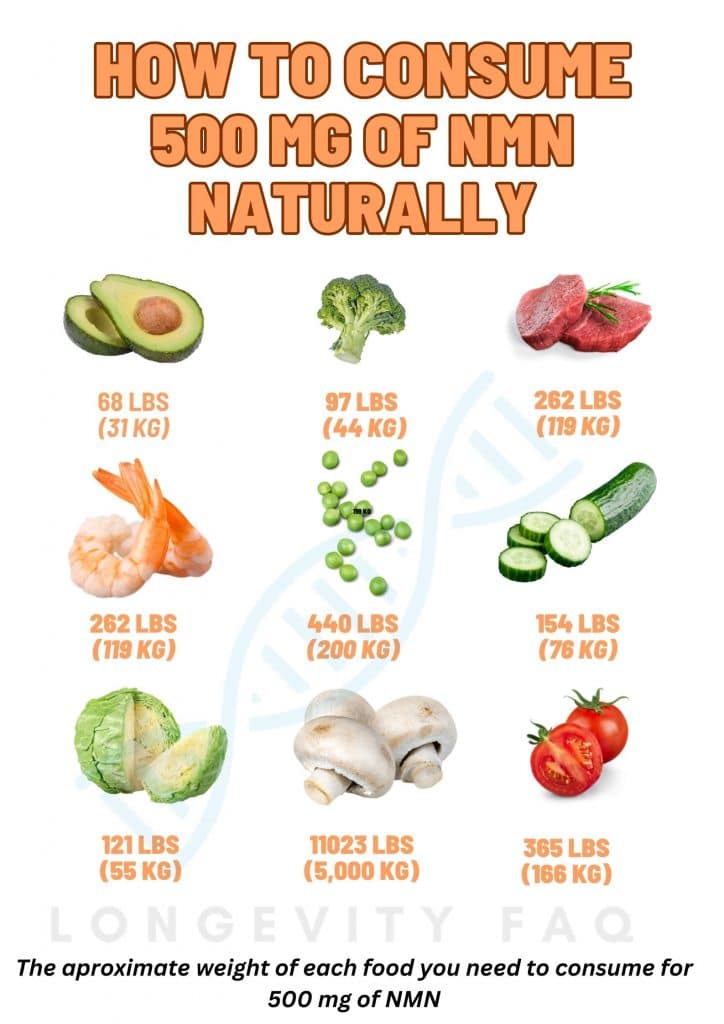
Here are some key points to help you understand the difference between getting NMN naturally through foods and through NMN supplementation:
- Natural Taste: Eating foods like avocados and broccoli is tasty and gives you a natural source of NMN.
- Convenience: Supplements are easy to take. Depending on the form I am taking I either scoup my NMN or take a capsule for my instant daily dose.
- Efficiency: NMN supplements can give a bigger boost to your <!– wp:image {“align”:”left”,”id”:6104,”sizeSlug”:”full”,”linkDestination”:”none”} –><figure class=”wp-block-image alignleft size-full”></figure><!– /wp:image –><!– wp:paragraph –>NAD, or nicotinamide adenine dinucleotide, is a coenzyme that is found in all cells and is essential to metabolism, in short NAD is critical in the chemical reactions that give all cells their energy, no or low NAD then cells don’t get the energy they need to function correctly.<br/><!– /wp:paragraph –><!– wp:paragraph –>More technically its significance lies in its role in redox reactions, where it carries electrons from one reaction to another. NAD exists in two forms: NAD⁺ and NADH, with the former serving as an oxidizing agent that accepts electrons from other molecules and becomes reduced, forming NADH, which can then be used as a reducing agent to donate electrons. This electron transfer is the primary function of NAD and plays a critical role in metabolism.<br/><!– /wp:paragraph –><!– wp:paragraph –>Additionally, NAD is used in other cellular processes, particularly as a substrate of enzymes in adding or removing chemical groups to or from proteins in posttranslational modifications. Due to its importance, enzymes involved in NAD metabolism are targets for drug discovery.<br>NAD⁺ has two general reactions in the human body: helping turn nutrients into energy as a key player in metabolism and working as a helper molecule for proteins that regulate other cellular functions. These processes are vital as NAD⁺ levels decline with age.<br/><!– /wp:paragraph –><!– wp:paragraph –>NAD can be synthesized de novo from simple building blocks like tryptophan or aspartic acid or derived from nutritive compounds like niacin. Moreover, some NAD is converted into the coenzyme nicotinamide adenine dinucleotide phosphate (NADP), which is a cofactor in anabolic metabolism.<br>The NAD⁺ chemical species’ superscripted addition sign reflects the formal charge on one of its nitrogen atoms; this species is a singly charged anion – carrying a (negative) ionic charge of 1 – under conditions of physiological pH.<br/><!– /wp:paragraph –><!– wp:heading –>Should I Supplement with NAD⁺ or a Precurcor like NMN or NR<!– /wp:heading –><!– wp:paragraph –>While we want to increase levels of NAD⁺ in our bodies, supplementing directly with NAD⁺ is not the answer; the reason is that NAD⁺ is a large molecule, so it’s always broken down in the stomach; the solution is to supplement with a precursor like NMN or NR.<br/><!– /wp:paragraph –><!– wp:paragraph –>There are several NAD⁺ precursors; these include:<br/><!– /wp:paragraph –><!– wp:list –><!– wp:list-item –>Nicotinamide Riboside (NR)<br/><!– /wp:list-item –><!– wp:list-item –> Nicotinic Acid (NA)<br/><!– /wp:list-item –><!– wp:list-item –> Nicotinamide (NAM)<br/><!– /wp:list-item –><!– wp:list-item –> Nicotinamide Mononucleotide (NMN)<br/><!– /wp:list-item –><!– wp:list-item –> Tryptophan (TRP)<br/><!– /wp:list-item –><br/><!– /wp:list –><!– wp:paragraph –>The latest research suggests that supplementing with NMN is the most effective way of boosting NAD⁺, much better than supplementing with NR, as you will see in the diagram below as NMN is closer in the NAD⁺ Biosynthetic Pathway, in short NR first needs to be converted into NMN before NAD⁺.<br/><!– /wp:paragraph –><!– wp:image {“align”:”center”,”id”:6103,”sizeSlug”:”full”,”linkDestination”:”none”} –><figure class=”wp-block-image aligncenter size-full”></figure><!– /wp:image –><!– wp:heading –>NAD History and Research<!– /wp:heading –><!– wp:paragraph –>The discovery of NAD⁺ can be credited to the British biochemists Arthur Harden and William John Young in 1906, who identified it as a nucleotide sugar phosphate by Hans von Euler-Chelpin. Otto Heinrich Warburg advanced the science in the 1930s by researching NAD+ and its role in metabolic reactions. Later, Conrad Elvehjem discovered that niacin is used to synthesize NAD⁺.<br/><!– /wp:paragraph –><!– wp:paragraph –>Recent research has also shown that NAD⁺ is critical in promoting longevity. Studies have found that boosting NAD⁺ levels can improve mitochondrial function, increase energy production, and enhance DNA repair. Furthermore, NAD⁺ has been shown to activate sirtuins, a group of enzymes associated with aging and longevity.<br/><!– /wp:paragraph –><!– wp:paragraph –>In addition to its role in metabolism and cellular processes, NAD⁺ is also involved in various disease states. For example, NAD⁺ levels decrease in several age-related diseases, including Alzheimer’s disease and Parkinson’s disease. Moreover, NAD⁺ has been shown to play a protective role in cardiovascular diseases, such as heart failure and hypertension.<br/><!– /wp:paragraph –>” href=”https://longevityfaq.com/glossary/nad/” data-mobile-support=”0″ data-gt-translate-attributes=”[{“attribute”:”data-cmtooltip”, “format”:”html”}]” tabindex=’0′ role=”link”>NAD+ levels than food can.
- Balance: Including NMN-rich foods in your diet is healthy, but for a significant NMN intake, supplements might be necessary.
I created the above diagram to show how much you would need to consume of each food in order to achieve an equlivelant dosage as 500mg of NMN supplementas you can see it would be impossible to consume a standard dose of NMN naturally, ps to find out a starting dose of NMN take a look at my NMN Dosage Calculator. if your estimated daily dose came in at 500mg you would need to consume 68 pounds (31 kilograms) of avacado which is the food with one of the highest naturally occuring concentrations of NMN, so personally I take a hybrid approch by focusing on foods naturally high in NMN as well as supplementing, this ensures I get the <!– wp:image {“align”:”left”,”id”:6104,”sizeSlug”:”full”,”linkDestination”:”none”} –><figure class=”wp-block-image alignleft size-full”></figure><!– /wp:image –><!– wp:paragraph –>NAD, or nicotinamide adenine dinucleotide, is a coenzyme that is found in all cells and is essential to metabolism, in short NAD is critical in the chemical reactions that give all cells their energy, no or low NAD then cells don’t get the energy they need to function correctly.<br/><!– /wp:paragraph –><!– wp:paragraph –>More technically its significance lies in its role in redox reactions, where it carries electrons from one reaction to another. NAD exists in two forms: NAD⁺ and NADH, with the former serving as an oxidizing agent that accepts electrons from other molecules and becomes reduced, forming NADH, which can then be used as a reducing agent to donate electrons. This electron transfer is the primary function of NAD and plays a critical role in metabolism.<br/><!– /wp:paragraph –><!– wp:paragraph –>Additionally, NAD is used in other cellular processes, particularly as a substrate of enzymes in adding or removing chemical groups to or from proteins in posttranslational modifications. Due to its importance, enzymes involved in NAD metabolism are targets for drug discovery.<br>NAD⁺ has two general reactions in the human body: helping turn nutrients into energy as a key player in metabolism and working as a helper molecule for proteins that regulate other cellular functions. These processes are vital as NAD⁺ levels decline with age.<br/><!– /wp:paragraph –><!– wp:paragraph –>NAD can be synthesized de novo from simple building blocks like tryptophan or aspartic acid or derived from nutritive compounds like niacin. Moreover, some NAD is converted into the coenzyme nicotinamide adenine dinucleotide phosphate (NADP), which is a cofactor in anabolic metabolism.<br>The NAD⁺ chemical species’ superscripted addition sign reflects the formal charge on one of its nitrogen atoms; this species is a singly charged anion – carrying a (negative) ionic charge of 1 – under conditions of physiological pH.<br/><!– /wp:paragraph –><!– wp:heading –>Should I Supplement with NAD⁺ or a Precurcor like NMN or NR<!– /wp:heading –><!– wp:paragraph –>While we want to increase levels of NAD⁺ in our bodies, supplementing directly with NAD⁺ is not the answer; the reason is that NAD⁺ is a large molecule, so it’s always broken down in the stomach; the solution is to supplement with a precursor like NMN or NR.<br/><!– /wp:paragraph –><!– wp:paragraph –>There are several NAD⁺ precursors; these include:<br/><!– /wp:paragraph –><!– wp:list –><!– wp:list-item –>Nicotinamide Riboside (NR)<br/><!– /wp:list-item –><!– wp:list-item –> Nicotinic Acid (NA)<br/><!– /wp:list-item –><!– wp:list-item –> Nicotinamide (NAM)<br/><!– /wp:list-item –><!– wp:list-item –> Nicotinamide Mononucleotide (NMN)<br/><!– /wp:list-item –><!– wp:list-item –> Tryptophan (TRP)<br/><!– /wp:list-item –><br/><!– /wp:list –><!– wp:paragraph –>The latest research suggests that supplementing with NMN is the most effective way of boosting NAD⁺, much better than supplementing with NR, as you will see in the diagram below as NMN is closer in the NAD⁺ Biosynthetic Pathway, in short NR first needs to be converted into NMN before NAD⁺.<br/><!– /wp:paragraph –><!– wp:image {“align”:”center”,”id”:6103,”sizeSlug”:”full”,”linkDestination”:”none”} –><figure class=”wp-block-image aligncenter size-full”></figure><!– /wp:image –><!– wp:heading –>NAD History and Research<!– /wp:heading –><!– wp:paragraph –>The discovery of NAD⁺ can be credited to the British biochemists Arthur Harden and William John Young in 1906, who identified it as a nucleotide sugar phosphate by Hans von Euler-Chelpin. Otto Heinrich Warburg advanced the science in the 1930s by researching NAD+ and its role in metabolic reactions. Later, Conrad Elvehjem discovered that niacin is used to synthesize NAD⁺.<br/><!– /wp:paragraph –><!– wp:paragraph –>Recent research has also shown that NAD⁺ is critical in promoting longevity. Studies have found that boosting NAD⁺ levels can improve mitochondrial function, increase energy production, and enhance DNA repair. Furthermore, NAD⁺ has been shown to activate sirtuins, a group of enzymes associated with aging and longevity.<br/><!– /wp:paragraph –><!– wp:paragraph –>In addition to its role in metabolism and cellular processes, NAD⁺ is also involved in various disease states. For example, NAD⁺ levels decrease in several age-related diseases, including Alzheimer’s disease and Parkinson’s disease. Moreover, NAD⁺ has been shown to play a protective role in cardiovascular diseases, such as heart failure and hypertension.<br/><!– /wp:paragraph –>” href=”https://longevityfaq.com/glossary/nad/” data-mobile-support=”0″ data-gt-translate-attributes=”[{“attribute”:”data-cmtooltip”, “format”:”html”}]” tabindex=’0′ role=”link”>NAD+ boost that my ageing body needs as well as getting the benefits of fibre, polyphenols, anti-axidants including Omega 3, plus many more
Incorporating NMN Into Diets
Incorporating NMN-rich foods into your daily meals can boost your body’s <!– wp:image {“align”:”left”,”id”:6104,”sizeSlug”:”full”,”linkDestination”:”none”} –><figure class=”wp-block-image alignleft size-full”></figure><!– /wp:image –><!– wp:paragraph –>NAD, or nicotinamide adenine dinucleotide, is a coenzyme that is found in all cells and is essential to metabolism, in short NAD is critical in the chemical reactions that give all cells their energy, no or low NAD then cells don’t get the energy they need to function correctly.<br/><!– /wp:paragraph –><!– wp:paragraph –>More technically its significance lies in its role in redox reactions, where it carries electrons from one reaction to another. NAD exists in two forms: NAD⁺ and NADH, with the former serving as an oxidizing agent that accepts electrons from other molecules and becomes reduced, forming NADH, which can then be used as a reducing agent to donate electrons. This electron transfer is the primary function of NAD and plays a critical role in metabolism.<br/><!– /wp:paragraph –><!– wp:paragraph –>Additionally, NAD is used in other cellular processes, particularly as a substrate of enzymes in adding or removing chemical groups to or from proteins in posttranslational modifications. Due to its importance, enzymes involved in NAD metabolism are targets for drug discovery.<br>NAD⁺ has two general reactions in the human body: helping turn nutrients into energy as a key player in metabolism and working as a helper molecule for proteins that regulate other cellular functions. These processes are vital as NAD⁺ levels decline with age.<br/><!– /wp:paragraph –><!– wp:paragraph –>NAD can be synthesized de novo from simple building blocks like tryptophan or aspartic acid or derived from nutritive compounds like niacin. Moreover, some NAD is converted into the coenzyme nicotinamide adenine dinucleotide phosphate (NADP), which is a cofactor in anabolic metabolism.<br>The NAD⁺ chemical species’ superscripted addition sign reflects the formal charge on one of its nitrogen atoms; this species is a singly charged anion – carrying a (negative) ionic charge of 1 – under conditions of physiological pH.<br/><!– /wp:paragraph –><!– wp:heading –>Should I Supplement with NAD⁺ or a Precurcor like NMN or NR<!– /wp:heading –><!– wp:paragraph –>While we want to increase levels of NAD⁺ in our bodies, supplementing directly with NAD⁺ is not the answer; the reason is that NAD⁺ is a large molecule, so it’s always broken down in the stomach; the solution is to supplement with a precursor like NMN or NR.<br/><!– /wp:paragraph –><!– wp:paragraph –>There are several NAD⁺ precursors; these include:<br/><!– /wp:paragraph –><!– wp:list –><!– wp:list-item –>Nicotinamide Riboside (NR)<br/><!– /wp:list-item –><!– wp:list-item –> Nicotinic Acid (NA)<br/><!– /wp:list-item –><!– wp:list-item –> Nicotinamide (NAM)<br/><!– /wp:list-item –><!– wp:list-item –> Nicotinamide Mononucleotide (NMN)<br/><!– /wp:list-item –><!– wp:list-item –> Tryptophan (TRP)<br/><!– /wp:list-item –><br/><!– /wp:list –><!– wp:paragraph –>The latest research suggests that supplementing with NMN is the most effective way of boosting NAD⁺, much better than supplementing with NR, as you will see in the diagram below as NMN is closer in the NAD⁺ Biosynthetic Pathway, in short NR first needs to be converted into NMN before NAD⁺.<br/><!– /wp:paragraph –><!– wp:image {“align”:”center”,”id”:6103,”sizeSlug”:”full”,”linkDestination”:”none”} –><figure class=”wp-block-image aligncenter size-full”></figure><!– /wp:image –><!– wp:heading –>NAD History and Research<!– /wp:heading –><!– wp:paragraph –>The discovery of NAD⁺ can be credited to the British biochemists Arthur Harden and William John Young in 1906, who identified it as a nucleotide sugar phosphate by Hans von Euler-Chelpin. Otto Heinrich Warburg advanced the science in the 1930s by researching NAD+ and its role in metabolic reactions. Later, Conrad Elvehjem discovered that niacin is used to synthesize NAD⁺.<br/><!– /wp:paragraph –><!– wp:paragraph –>Recent research has also shown that NAD⁺ is critical in promoting longevity. Studies have found that boosting NAD⁺ levels can improve mitochondrial function, increase energy production, and enhance DNA repair. Furthermore, NAD⁺ has been shown to activate sirtuins, a group of enzymes associated with aging and longevity.<br/><!– /wp:paragraph –><!– wp:paragraph –>In addition to its role in metabolism and cellular processes, NAD⁺ is also involved in various disease states. For example, NAD⁺ levels decrease in several age-related diseases, including Alzheimer’s disease and Parkinson’s disease. Moreover, NAD⁺ has been shown to play a protective role in cardiovascular diseases, such as heart failure and hypertension.<br/><!– /wp:paragraph –>” href=”https://longevityfaq.com/glossary/nad/” data-mobile-support=”0″ data-gt-translate-attributes=”[{“attribute”:”data-cmtooltip”, “format”:”html”}]” tabindex=’0′ role=”link”>NAD+ levels and may contribute to better health and longevity. You might wonder, ‘What are the best foods to eat for NMN?’ Start by adding members of cruciferous vegetables like broccoli and cabbage to your plate. These veggies aren’t only good for you but are also foods high in NMN.
Think about making your meals colorful and full of variety. Toss some avocado into your salad or make a fresh cucumber dish. These foods aren’t only tasty but also pack a punch of nicotinamide mononucleotide (NMN), a dietary ingredient that your body needs to keep itself in top shape.
Don’t be afraid to experiment in the kitchen. Whip up a smoothie with banana and add a handful of greens for an NMN boost. Or, how about avocado toast for breakfast? It’s a simple yet effective way to get your NMN fix. When you’re planning your meals, remember to include a mix of these NMN-rich foods to help keep your body’s <!– wp:image {“align”:”left”,”id”:6104,”sizeSlug”:”full”,”linkDestination”:”none”} –><figure class=”wp-block-image alignleft size-full”></figure><!– /wp:image –><!– wp:paragraph –>NAD, or nicotinamide adenine dinucleotide, is a coenzyme that is found in all cells and is essential to metabolism, in short NAD is critical in the chemical reactions that give all cells their energy, no or low NAD then cells don’t get the energy they need to function correctly.<br/><!– /wp:paragraph –><!– wp:paragraph –>More technically its significance lies in its role in redox reactions, where it carries electrons from one reaction to another. NAD exists in two forms: NAD⁺ and NADH, with the former serving as an oxidizing agent that accepts electrons from other molecules and becomes reduced, forming NADH, which can then be used as a reducing agent to donate electrons. This electron transfer is the primary function of NAD and plays a critical role in metabolism.<br/><!– /wp:paragraph –><!– wp:paragraph –>Additionally, NAD is used in other cellular processes, particularly as a substrate of enzymes in adding or removing chemical groups to or from proteins in posttranslational modifications. Due to its importance, enzymes involved in NAD metabolism are targets for drug discovery.<br>NAD⁺ has two general reactions in the human body: helping turn nutrients into energy as a key player in metabolism and working as a helper molecule for proteins that regulate other cellular functions. These processes are vital as NAD⁺ levels decline with age.<br/><!– /wp:paragraph –><!– wp:paragraph –>NAD can be synthesized de novo from simple building blocks like tryptophan or aspartic acid or derived from nutritive compounds like niacin. Moreover, some NAD is converted into the coenzyme nicotinamide adenine dinucleotide phosphate (NADP), which is a cofactor in anabolic metabolism.<br>The NAD⁺ chemical species’ superscripted addition sign reflects the formal charge on one of its nitrogen atoms; this species is a singly charged anion – carrying a (negative) ionic charge of 1 – under conditions of physiological pH.<br/><!– /wp:paragraph –><!– wp:heading –>Should I Supplement with NAD⁺ or a Precurcor like NMN or NR<!– /wp:heading –><!– wp:paragraph –>While we want to increase levels of NAD⁺ in our bodies, supplementing directly with NAD⁺ is not the answer; the reason is that NAD⁺ is a large molecule, so it’s always broken down in the stomach; the solution is to supplement with a precursor like NMN or NR.<br/><!– /wp:paragraph –><!– wp:paragraph –>There are several NAD⁺ precursors; these include:<br/><!– /wp:paragraph –><!– wp:list –><!– wp:list-item –>Nicotinamide Riboside (NR)<br/><!– /wp:list-item –><!– wp:list-item –> Nicotinic Acid (NA)<br/><!– /wp:list-item –><!– wp:list-item –> Nicotinamide (NAM)<br/><!– /wp:list-item –><!– wp:list-item –> Nicotinamide Mononucleotide (NMN)<br/><!– /wp:list-item –><!– wp:list-item –> Tryptophan (TRP)<br/><!– /wp:list-item –><br/><!– /wp:list –><!– wp:paragraph –>The latest research suggests that supplementing with NMN is the most effective way of boosting NAD⁺, much better than supplementing with NR, as you will see in the diagram below as NMN is closer in the NAD⁺ Biosynthetic Pathway, in short NR first needs to be converted into NMN before NAD⁺.<br/><!– /wp:paragraph –><!– wp:image {“align”:”center”,”id”:6103,”sizeSlug”:”full”,”linkDestination”:”none”} –><figure class=”wp-block-image aligncenter size-full”></figure><!– /wp:image –><!– wp:heading –>NAD History and Research<!– /wp:heading –><!– wp:paragraph –>The discovery of NAD⁺ can be credited to the British biochemists Arthur Harden and William John Young in 1906, who identified it as a nucleotide sugar phosphate by Hans von Euler-Chelpin. Otto Heinrich Warburg advanced the science in the 1930s by researching NAD+ and its role in metabolic reactions. Later, Conrad Elvehjem discovered that niacin is used to synthesize NAD⁺.<br/><!– /wp:paragraph –><!– wp:paragraph –>Recent research has also shown that NAD⁺ is critical in promoting longevity. Studies have found that boosting NAD⁺ levels can improve mitochondrial function, increase energy production, and enhance DNA repair. Furthermore, NAD⁺ has been shown to activate sirtuins, a group of enzymes associated with aging and longevity.<br/><!– /wp:paragraph –><!– wp:paragraph –>In addition to its role in metabolism and cellular processes, NAD⁺ is also involved in various disease states. For example, NAD⁺ levels decrease in several age-related diseases, including Alzheimer’s disease and Parkinson’s disease. Moreover, NAD⁺ has been shown to play a protective role in cardiovascular diseases, such as heart failure and hypertension.<br/><!– /wp:paragraph –>” href=”https://longevityfaq.com/glossary/nad/” data-mobile-support=”0″ data-gt-translate-attributes=”[{“attribute”:”data-cmtooltip”, “format”:”html”}]” tabindex=’0′ role=”link”>NAD+ levels up.
Sometimes, though, you might need more NMN from food alone. In that case, consider NMN supplementation. This will fill the gaps and ensure you reach your desired NMN daily dosage. I also recommend reading my article titled The Ultimate Guide to NMN Supplementation for a more broader look at NMN in its supplement form and how it relates to longevity and ageing.
Natural NMN Sources Frequently Asked Questions
What Food Has the Highest Amount of NMN?
Edamame (young soybeans) and avocado are the two foods with the highest consentrations of NMN with up to 1.60 mg per 100g, it’ll give you the most bang for your buck. Include it in your meals for a boost.
How Can I Increase My NMN Naturally?
Yes you can to naturally boost your NMN levels, you’ll want to eat more broccoli, cabbage, avocados, and edamame. These foods are packed with NMN, which is key for your energy and cellular health.
What Form of NMN Is Best?
You’ll want to pick a pure, high-quality NMN supplement for the best results. Look for third-party testing and good reviews to ensure you’re getting an effective product.
Click to Copy